Author Archives: RevJule

Unknown's avatar

About RevJule

RevJule is a pastor of the Presbyterian Church (USA). She is The Rev. Dr. Jule, who holds a BA in Theology from Valparaiso University, a Masters of Divinity from Vanderbilt University Divinity School, and a Doctorate of Ministry (in Gospel and Culture) from Columbia Theological Seminary of Decatur, GA. She soon recently completed a Certificate of Christian Spiritual Formation from Columbia Theological Seminary of Decatur, GA and is beginning to be trained as a Spiritual Director through the Haden Institute in North Carolina. RevJule has served in a variety of professional ministry settings ranging from specialized ministry among children and families to adult ministry to solo pastorate work. She began writing almost before she could read and it was her way to connect deeply with God, others, and her truest self. RevJule currently enjoys creating weekly worship experiences and sermons for a congregation she is leading on a journey of self-re-definition. She enjoys teaching and connecting with others about matters of faith and life. She makes time almost daily for sitting quietly, being with her closest friends, walking her toy poodle Rufus, reading great books, and digging into the soil of whatever garden she can create. If you like what you are reading here, contact her to schedule a retreat or other spiritual formation experience for your faith community.

Pilgrimage Remembrances #1

It’s been a year — almost to the date.  And so, I’m revisiting the trip.  Quite a journey!  My pilgrimage to the Holy Land in Lent 2014.  One year later, my journal entries take me back.  I hope they give insight and meaning to your Lenten season this year.

Bread on our Journeys!

RevJule

8 March 2014:  So a new day.  Yesterday was so amazing!  (I’m one day behind on my posts of the pilgrimage, so just enjoy what is shared here!)

A View of Magdala and the Valley Road (or Valley of Doves) from Mount Arbel.  (Jesus' route from home in Nazareth to the Sea of Galilee).

A View of Magdala and the Valley Road (or Valley of Doves) from Mount Arbel. (Jesus’ route from home in Nazareth to the Sea of Galilee).

Tabgha:  The Multiplication of the Loaves and Fish.

Tabgha: The Multiplication of the Loaves and Fish.

15890045

So many incredible moments here (in Galilee on 7 March 2014)!  Such a beautiful country.  And so moving to contemplate where Jesus grew up and played and rested and called and taught and healed and replenished himself with Peter and his friends and family.  The backdrop of his life — this geography — is amazing!  The meeting place of all the nations for rest is where he made his home during much of his ministry:  Capernaum in the home of Peter.  Capernaum, one of the wealthiest and largest towns in Galilee in his day, was at the northeast corner of Galilee.  The meeting place of all nations — Jordan and Syria and Israel!  It had to be a huge influence on his understanding of God being about peace — unity.  Harmony with one another no matter what.  The judgment that was in him was discernment based on that SHALOM.  That absolute, wide-expanse of love!

A View at Capernaum from the Sea of Galilee to the Synagogue -- Peter's home (not pictured) between the two.

A View at Capernaum from the Sea of Galilee to the Synagogue — Peter’s home (not pictured) between the two.

Sea of Galilee from the Mount of the Beatitudes.  "And Jesus said, 'Blessed are the peacemakers; for they will be called children of God'." (Matthew 5:9)

Sea of Galilee from the Mount of the Beatitudes. “And Jesus said, ‘Blessed are the peacemakers; for they will be called children of God’.” (Matthew 5:9)

And now . . .  onto the Sea of Galilee!

So here we are on a boat on the Sea of Galilee! And the waves are a’rocken. But they were fishermen – on this very water! Certainly they experienced rough waters on this little lake before. I guess they weren’t all fishermen. So I could see how they were afraid.
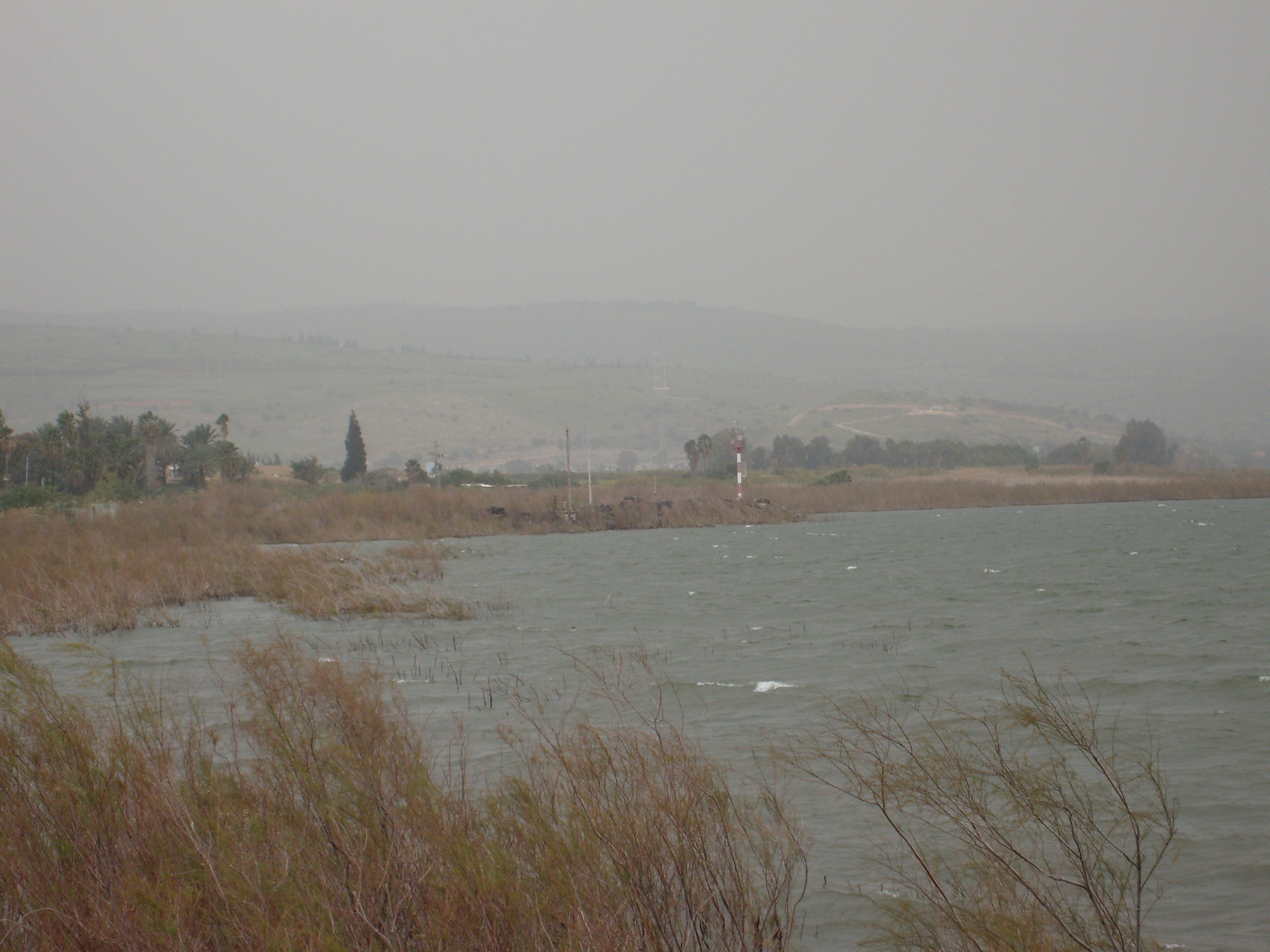
The Sea of Galilee.

The Sea of Galilee.

(Later): As it turned out, we had to cut our boat ride short because a storm from the south suddenly swept in. Rain started – great big pellet kind of drops. It seemed the boat captain was afraid. He didn’t want us stuck out there. Neither did he want us (or his boat) injured!

A sudden storm began.  8 March 2014.

A sudden storm began. 8 March 2014.

When the storm started, I immediately was taken back to the last cruise I had been on. As we set sail on the ocean, that huge ship started rocking. I was on a massage table at the time – a bon voyage discount. I remember fighting it at first. Then relaxing into the waves – rocking with the water instead of against it. Deepening myself in trust. In those moments, I grew certain that the God who created the universe — the God who created me — held us all. Held me. . . . No matter the storms that blow. No matter how much that boat today on the Sea of Galilee was rocking, we were held. No need to fear. I totally can imagine Jesus falling asleep in that trust. Secure. Because gently the waves remind us that God holds us through it all. In tender love, in strong bonds that never, ever, ever will let us go. Gently we can relax into the gift of those rocking waves — those sudden storms of life.

O you of little faith, why EVER do you fear?

God, hold me each step of the way.

First Century boat excavated from the Sea of Galilee.

First Century boat excavated from the Sea of Galilee.

And now: onto the Church of the Primacy of Peter.  “Then Peter said,

  ‘I am going fishing . . .’” (John 21)

Lord, after your resurrection, here it was you came – as a surprise – to greet your wayward disciples. To feed them. To love them. To get them ready to be sent. What did they feel in those moments after your horrible death and rumored resurrection? What did they think? Were they ready? Did they believe themselves equipped?

You Lord, you as the Risen Christ, came to them – as surprise. Unrecognized at first. And to them you said: “Come. Eat. Be nourished. Now go in our love for one another. It’s not just about me — or for me. It’s for the benefit of my sheep. Go: feed them. Tend them. Love them. Show them.”

The Church of the Primacy of Peter (where the Risen Christ fed his disciples on the beach on the Sea of Galilee).

The Church of the Primacy of Peter (where the Risen Christ fed his disciples on the beach on the Sea of Galilee).

So easily we can be distracted. Caught up in that which is around us. Nearly trampled by that which is other than your command to serve. Yet you show up.  . . .  After you feed us, you send us. And it’s not just a one-time taste meant to fill us up for good. Not a one-time meal and that’s enough. Instead: over and over again. It’s a cycle. “Rest with me as you eat. Feed. Now go. . . . Eat. Feed. Go. Eat. Feed. Go.”

From this beach you sent them on a journey in which they would never ever be the same. From here you send us all on a journey to be changed. To change. To falter and then to get back up again – like you after crucifixion: again (thanks be to God) you stood up!

8 March 2014 - at Primacy of Peter, Sea of Galilee.

8 March 2014 – at Primacy of Peter, Sea of Galilee.

This might as well be the beach called Genesis: the start of new beginnings. This might as well be my spot. A fresh start. A re-freshed beginning.

Thank you God for the food of this place. The nourishment of fellow pilgrims who also are sent to serve on your behalf in this world. Thank you for simple gifts: remembrance. Bread. Wine. Vision. Beautiful inspiration. A chance to hear and begin again.

Lord, you did not shame them in their distraction – their return to fishing after your death. In their fear. In their doubt:  you met them where they had wandered. Then you simply asked: “Is there love in that heart for me? . . .  That is enough!  Go: feed others who need the same kind of sustenance for their walk in this world. I will be with you. I will surprise. I will be revealed. I will provide. It shall be enough.”

The Lord's Table at the Primacy of Peter, Galilee; 8 March 2014.

The Lord’s Table at the Primacy of Peter, Galilee; 8 March 2014.

All shall be well . . . thanks be to God!

-RevJule

(Copyright JMN-2015. All rights reserved.)

Our Crosses

DISCLAIMER: I believe sermons are meant to be heard. They are the word proclaimed in a live exchange between God and the preacher, and the preacher and God, and the preacher and the people, and the people and the preacher, and the people and God, and God and the people. Typically set in the context of worship and always following the reading of scripture, sermons are about listening and speaking and hearing and heeding. At the risk of stepping outside such boundaries, I share sermons here — where the reader will have to wade through a manuscript that was created to be spoken word. Even if you don’t know the sound of my voice, let yourself hear as you read. Let your mind see as you hear. Let your life be opened to whatever response you begin to hear within you.

May the Spirit Speak to you!
RevJule
______________________

A sermon for 1 March 2015 – Second Sunday During the Season of Lent

Click here to read scripture first: http://www.biblestudytools.com/nrsa/mark/passage/?q=mark+8:31-38

It’s Lent, so I guess public confession is good.  Here goes. Someone really hurt my feelings last week. Don’t worry – it wasn’t anyone connected to the church!  It was something someone else I know said to me, about me, last week. And it hurt. My ego got bumped. I got mad.   . . .  Am I the only one this ever happens to?   . . .  For at least the first two days, I wanted to call up my best friends and trash talk. Tell them all about it. Point fingers at the person who said what they said. Get them on my side about it all just so I would be justified.   . . .  Seriously: am I the only one stuff like this ever happens to?   I don’t think so, though I realize some of us are further along on the continuum regarding such things.

Recently I heard a beloved, deep-on-the-journey spiritual leader talk about it on national television. The interviewer asked him something about him living each day in the flow or absolute love of God. And he confessed that though he writes and talks eloquently about the absolute love of God – the Ground of our very being, sometimes he’s there. But not always. And some weeks not even every day. This is someone who has devoted his life to daily silence, scripture reading, study, communal living, and prayer. He’s sought after worldwide for in-person lectures. His printed works sell millions and his visual and audio recordings are bringing life to Christians all across the globe. And still, after nearly fifty years of the practice, he claims his own ego still gets bumped. People say things or do things that rub him wrong and before he knows it, he feels that pain. Now, thanks to his daily, life-long practices, he admits such annoyances come and go fairly quickly for him now – even things like getting cut off in traffic. Anyone get all worked up about that? But he doesn’t have that urge to call up BFFs to tell them all about it. And he doesn’t stew either –as the less verbal among us tend to do, right? Just soaking in our juices. Fuming about what so and so did or said that really got our goat.

It’s the first thing that comes to mind from Jesus’ words of the gospel of Mark. “If any want to become my followers, let them deny themselves and take up their cross and follow me” (Mark 8:34). It would be easy to keep such words way back then in history. Thinking about Peter, James, and John literally having to give up the regular ways of their lives to follow Jesus around Galilee before finally heading to Jerusalem. But the message isn’t just for those long ago. It’s for every last one of us. Today. In the real stuff of our lives.

If you were at Wednesday night to see it, or watched the link of the video we email blasted (click here to watch it:   https://vimeo.com/116071300) that was by the Barna Group about their findings regarding the unchurched, then you might remember that one of the major hurdles to Christianity today is that the unchurched, or church-less as they were calling them, cannot see any distinctive difference between how they are living their lives and how most of us church people are living ours. Ouch! The research showed that other than us being in worship sometimes on Sundays, for the most part, the daily lives and choices of most American Christians do not look all that different from the daily lives and choices of the church-less. Chilling, isn’t it? Because the One we claim to follow was pretty clear that we are not to be living the same as everyone else. In a world of rampant consumerism, self-absorbed self-interest, and escalating violence; we should stand out. It should be seen that we give of at least a portion of our time, talents, and money not for our own pleasure but for the benefit of others. It should be seen that we curb our appetites for more, more, more. It should be seen that, if nowhere else in this world, at least among us Christians forgiveness is genuinely practiced – love for all no matter what is the norm. All those good fruits of the Spirit like love, joy, peace, patience, kindness, and self-control (Galatians 5:22). It should be seen that we’re not about us and them but about one, beloved human family. One, united creation actually, that all is sacred unto God.   . . .  As an example to demonstrate his point, the Barna researcher spoke of an ancient practice of God’s people that can be incredibly relevant for today: keeping Sabbath. True rest as a creature in our amazing Creator without all our techno-gadgets. The point being that if others see us able to use, but not be addicted to our screens, like actually NOT all being on our smartphones as we sit at a meal in a restaurant. You’ve seen that, right? Dad taking a work call. Mom searching the web for something, and little Christian children playing whatever app they’re playing when the server comes to take their order. Sabbath just one day a week – or one hour if the consideration of one full day causes you an immediate sense of panic. Stopping from life like that, to rest in the natural beauty of this world. Truly connecting with one another face-to-face and even with our God; well, that would be one way to be an authentic witness today of denying ourselves to follow after the principles of another.

Our crosses might not look like the bloody devices of torture used by Rome to put to death anyone seeking to incite the people against their ways. Our crosses might look like practicing daily meditation so that we’re not as attached to the bumps and bruises of our egos. Steeping ourselves in the words and actions of Christ that the ways we interact with others blare with mercy and kindness and grace. The sacrifice of our own hidden agendas are seen by our colleagues out there in the world and even in here in the church. Not being doormats for everyone else to walk all over. Being our best selves in God by losing how we always want it to be for the sake of God’s grander vision to grow.

You know, the one who says to follow didn’t have to show up here in this world and live the kind of life he did. Jesus could have gone about his little carpenter life – eking out a living for the benefit of his own family. Keeping his unique worldview and talents to himself. He could have had year after year of his life used up just by getting by each day – trying merely to make it from sunup to sundown accomplishing the duties laid upon him by his business and family and friends. Or by making and taking more for himself, even at the expense of others. But he didn’t, did he? Which is why we know anything about him at all – this man who was truly one of us and yet truly of God as well. He turned to the Spirit. He gave space enough for God’s truth to grow in him. He enjoyed others – cherishing them, not trying to figure out how they could benefit himself. He quieted his own wants – probably by the times he daily stole off to be alone in prayer with God – until his only want was summed up in that amazing prayer in the garden: “Thy will be done, O God. Thy will.” That’s the way he was God with us. Showing us how to be Godlike in the world today.   . . .  With all the clamor and concern about how to live well these days, why do we look anywhere else but to the life of Jesus, the Christ?

“Those who want to save their own life,” he said, “will lose it.” But those who lose their life – giving up their own selves each day, like him? Those already know real Life! The point of it all.

In the name of the life-giving Father, the life-redeeming Son, and the life-sustaining Spirit, Amen.

© Copyright JMN – 2015  (All rights reserved.)

Water and Ash

DISCLAIMER: I believe sermons are meant to be heard. They are the word proclaimed in a live exchange between God and the preacher, and the preacher and God, and the preacher and the people, and the people and the preacher, and the people and God, and God and the people. Typically set in the context of worship and always following the reading of scripture, sermons are about listening and speaking and hearing and heeding. At the risk of stepping outside such boundaries, I share sermons here — where the reader will have to wade through a manuscript that was created to be spoken word. Even if you don’t know the sound of my voice, let yourself hear as you read. Let your mind see as you hear. Let your life be opened to whatever response you begin to hear within you.

May the Spirit Speak to you!
RevJule
______________________

A sermon for 22 February 2015 – First Sunday during Season of Lent
Click here to read scripture first: http://www.biblestudytools.com/nrsa/mark/passage/?q=mark+1:9-15

I know we Presbyterians prefer to have it all decently and in order, but thanks to the weather of this week, we’re a bit out of order today. It’s the first Sunday during the season of Lent, but before all’s said and done today, it’s going to feel a bit more like Ash Wednesday/Sunday. . . . The act of the ashes traditionally begins the season of Lent. Having the cross traced on our foreheads in the stuff that symbolizes our mortality reminds us of the mystery of our faith. But for the grace of God: poof. We are just a pile of ash. Each year we are to remember that we are dust and to dust we shall return. But, thanks to the gracious love of God, that is NOT the end of our story. The gift of Ash Wednesday brings us back to our truth. And the gospel for the first Sunday during the season of Lent brings us back to our baptisms. It’s Jesus’ baptism actually, according to the gospel of Mark this year. So that, thanks to the turn of events in our weather this week, here we are today with water and ash.

One thing brings the two together. Oil. I know we don’t often use oil anymore in the Sacrament of Baptism. But it is called for according to the Presbyterian Book of Common Worship. In fact, it was an important part of baptism for early Christians. As far as we know, after an adult was fully immersed in the waters of baptism, they would kneel before the priest who would mark their forehead in oil with the sign of the cross. Laying hands upon them, the priest then would recite something close to what our baptismal rite calls for directly after the water in the name of the Father, Son, and Holy Spirit. Marking one’s forehead in the sign of a cross – in oil if able – the pastor says something like: “Child of the covenant, you are marked with God’s sign and God will keep the promises made to you in this sacrament forever” (modification of PCUSA’s Book of Common Worship, 1993, p. 414). It’s why we likewise begin funeral services with a reminder of a person’s baptism. Even in death, we are marked as God’s own.

You don’t see the oil we mix with the ash of Ash Wednesday. But it’s there: to ensure the ashes stick to your head. Perhaps a more practical presence for the oil, but we know of biblical traditions that call for the use oil on our faces during times of penitential fasts. We’re not to call attention to ourselves in our faithful discipleship of Christ. Matthew 6, the gospel text assigned for Ash Wednesday every year, instructs not to fast as hypocrites who are trying to clamor for attention over their holiness. Rather, Matthew records: “When you fast, put oil on your head and wash your face, so that your fasting may be seen not by others but by your father who is in secret” (Mt. 6:17-18a).

Oil had another use in ancient Israel. For all we know, oil was how God’s kings were anointed. First and Second Kings both record the coronation of kings, Solomon and Joash. Trumpets are blown. Oil is used for anointing. And all the people shout: “Long live the king!” (I Kings 1:38-40 and 2 Kings 11:9-12). The kings were not God present to the people – they weren’t deified. But they were considered sanctified – made holy and empowered by God. Anointed with oil for the work to which God called them. (For further details, see http://www.jhom.com – Coronation in ancient Israel.)

The intriguing thing is: this one, Jesus, the Anointed One of God, isn’t anointed with oil – at least not at the start of his ministry. Unlike Israel’s ancient kings, this new King, Jesus of Nazareth, claims the sign of water as that which sets him apart. Along with the long line of sinners standing on Jordan’s banks, Jesus begins his work “with his descent into the waters of baptism” (Leah McKell Horton, Feasting on the Gospels, Mark; p. 9). As one commentator writes: “This (king), who has come to save God’s people is not marked for his role in the ordinary way (of kings). Jesus, the Messiah, takes on an unexpected identity right from the start. Rather than being set apart from the rest of us sinners, he partakes of the same baptism, joining all the unclean there in the waters” (Ibid., p. 11). And so the work God gave him to do begins.

We are called to meditate upon it. The season of Lent is the church’s annual, intentional period of reflection. Marked with these signs: the waters of baptism and the ash of our mortality, we are called to live out our roles as sons and daughters of the King. We are not mere mortals – the signs on our foreheads set us apart. So that whether we remember or not, when God gazes upon us, God sees it clearly. I like to think of it that if God had a thumb, then the Holy One has trace right upon each one of us: I love you (in the sign of the cross). Marked with God’s sign, we’re heirs of the covenant. Children of the kingdom whose lives belong in line behind the One who lived and died and lived again.
In a time of silent reflection, let us ready ourselves to receive again, and thereafter live, God’s sign . . .

© Copyright JMN – 2015 (All rights reserved.)

All are Loved Here!

Recently I heard a story about a house made out of a cardboard box for a stray cat. It has been extremely cold around many parts of the USA and one pre-teen girl couldn’t stand it any longer for the cat frequently found outside around her home. She got busy. After a day of the box being all snuggled with a cozy blanket, a sign was added: “Shadow is Loved Here!” Not only did the girl name the cat, she attempted to lure it to the warmth of the make-shift home with the depths of her generous heart. She wanted that stray to know that the warmth of the house she had created for it was a place where it was fully loved. Welcomed. Home.

True story.

I want such a sign, don’t you?

One for each of us. A sign over every home to remind us why it even is home for us. Because we are loved unconditionally there. Sheltered from the storms of the rest of life. Welcomed in the safety of such a place where we are cherished. Feed. Protected.

What sign do you have over the threshold of your home? What sign do you have over the threshold of your own heart?

May we be generous enough with ourselves, with those in our homes, with those needing home, and with all — not only to post, but also to enact the message: All are loved here!

RevJule

Transfiguration: A Transformation Metaphor

DISCLAIMER: I believe sermons are meant to be heard. They are the word proclaimed in a live exchange between God and the preacher, and the preacher and God, and the preacher and the people, and the people and the preacher, and the people and God, and God and the people. Typically set in the context of worship and always following the reading of scripture, sermons are about listening and speaking and hearing and heeding. At the risk of stepping outside such boundaries, I share sermons here — where the reader will have to wade through a manuscript that was created to be spoken word. Even if you don’t know the sound of my voice, let yourself hear as you read. Let your mind see as you hear. Let your life be opened to whatever response you begin to hear within you.

May the Spirit Speak to you!
RevJule
______________________

15 February 2015 – Transfiguration Sunday
Click here to read scripture first: 

Impact

This post might sound a bit . . . overdone/expected/trite.

Nonetheless:  with great appreciation, affection, and respect; I write in honor of Alfred.  A man of amazing faith and love who has lived nearly 100 years.  Tonight I learned that he may be about to breathe his last and he wanted me to be the one to be there with him for his last rites — something I interpret as his last words to and from God.  If I was there tonight, I would hold up a mirror to his face and say:  “Love, Love, Love, Love.  From Love you came.  By Love you have lived all the days of your life.  To Love you return.  Know that you rest eternally in the amazing embrace of Love.”

The one of whom I write is a humble man who has made significant scientific contributions to this world, though the kinds of projects he has worked on for our government have haunted him many days of his life.   I had the pleasure of being his pastor for a brief part of his journey — the part in which he lost his younger sister and underwent several rounds of what we all expected would be his final days.  Last winter he declared he would live to another spring, to plant a garden and watch the fruits of his labors grow.  I have had the joy of getting to know one of his daughters, one who might just be the most faithfully, devoted, loving, fun-loving person in this world.  Her commitment to her family has been inspiring.  A smile comes to my lips every time I think of her and her dear, passing father.  It’s been over a year since last I saw them, but due to their loving generosity, I still sip tea each morning for which they are responsible!  (When Alfred found out I loved to drink a cup of tea in the morning, he made sure they got me a box or two every few weeks — even during the days he was hospitalized and during the time he was burying his younger sister!)  When I moved here a little over a year ago, I had a mid-size cardboard box full of boxes of tea!  Alfred always wanted to ensure I, as his pastor, had this little pleasure each day.  His heart is pure kindness.  Love.  Grace.

A box of my favorite Tea lovingly given to me by Alfred.

A box of my favorite Tea lovingly given to me by Alfred.

We never do know the kind of impact we have in this world.  Who we are can be given as such a gift.  In simple ways.  In ways that encourage along a fellow, struggling traveler.

In honor of an un-known man who gave not only of his brilliance, but also of his incredible generous spirit, be someone today that impacts this world forever for good!

So be it . . .

RevJule

A Worship Anomaly

Something happened in worship Sunday morning that I NEVER have seen before.  Not in 20 years of professional ministry — or the 20-some prior years of worship service attendance.

I was behind the table when I noticed it.  (And I’m not talking about the time a few months ago when I spilled the juice all over!)  Ruling Elders (those elected from the congregation to lead the congregation) were out among worshippers passing out the symbolic cup of salvation for all to drink.  I looked up and there it was:  a pile of mud smeared into the carpet right at the foot of the chancel area. It wasn’t there when we started. It must have happened along the way.

I was taken aback!

I realize this may sound ridiculous.  After all, it has been a rainy winter in these parts.  Mud has been all around us.  Every time I take out my dog for his walk, I have to tip-toe through soggy grass and try to avoid coming back inside covered in mud — or worse yet, the remains from other dogs which not all neighbors are picking up (though the signs warn of fines for those who don’t!).

Mud.  I expect it outside.  I’ve NEVER seen it before on the carpet at the foot of the chancel area in a Christian sanctuary!

Before I got back to take the photo, someone already had cleaned up the mud.  Faint remnants remain -- and the cleaning person hasn't even been in yet!  Might it be a sign of our discomfort with mud in the sanctuary?

Before I got back to take the photo, someone already had cleaned up the mud. Faint remnants remain — and the cleaning person hasn’t even been in yet! Might it be a sign of our discomfort with mud in the sanctuary?

A closer view of the remnants.

A closer view of the remnants.

It got me thinking of all the ways we seek to keep our mud out of worship.  According to the Genesis stories, we come from it.  And I’ve buried enough people to know that we return to it — whether in airtight vaults or strewn ashes of our remains.  But for the breath of the Divine, we’d be just that:  some earth, some water, in other words:  mud.

Why do we deny it?  Why do we try to keep the truth from ourselves and one another so that we can’t be really real about who we are — even in worship, when we gather seeking the presence of The Presence?  Why would we expect those who have been out in the world (trying their best to love the Holy, their neighbors, and themselves) not to have a little bit of mud on their shoes and in their souls?  What if that mud got there in the sanctuary because whoever put it there had been going an extra mile for someone else’s benefit last week?  What if that mud got there in the sanctuary because someone intentionally left it there to lay down the burden of where their feet had tread last week? What if that mud got there because someone, or The One, needed us to remember who we are, why we need each other, and what we are to be about in this world.

It really was a gift, that mud on the carpet at the foot of the chancel stairs this week.  I was preaching about us being as on the go as Christ was in his life like one of us on earth — heading out and about in the world to embody the love of God for all those who need to experience it.

Seems as if someone already had been at it.

Mud.

Praises be!

-RevJule

“The On the Go Jesus”

DISCLAIMER: I believe sermons are meant to be heard. They are the word proclaimed in a live exchange between God and the preacher, and the preacher and God, and the preacher and the people, and the people and the preacher, and the people and God, and God and the people. Typically set in the context of worship and always following the reading of scripture, sermons are about listening and speaking and hearing and heeding. At the risk of stepping outside such boundaries, I share sermons here — where the reader will have to wade through a manuscript that was created to be spoken word. Even if you don’t know the sound of my voice, let yourself hear as you read. Let your mind see as you hear. Let your life be opened to whatever response you begin to hear within you.

May the Spirit Speak to you!
RevJule
______________________

A sermon for 1 February 2015 – 4th Sunday after Epiphany
Click here to read scripture first: Mark 1:21-39 (NRS)

I grew up in a pretty small town so I can imagine the talk about Jesus going on back home. As the ladies of Nazareth gathered each day to go fetch water from the local well, can’t you just hear them cackling away: “And what in the world has gotten into Joseph and Mary’s boy? Thirty years old and he still hasn’t settled down. Is that boy ever going to commit? Out at the Jordan River near Jerusalem. Did you hear he went missing for something like 40 days? Who knows what in the world he was off doing!” Another one pipes in: “I hear he’s been hanging around the sea. Over near Capernaum at the northeastern corner of the district.” And another: “Well, what’s he going to do there on the edge of nowhere – or to everywhere beyond Israel, if he dared venture out of our land. I knew Mary wouldn’t make a proper Jewish mother what with her being pregnant during their betrothal and all.” Another woman jumps in: “If he was my son there’d be none of this racing all over Galilee stirring up the people. We need him back home tending his daily chores.” And another: “Some say he’s busting into synagogues everywhere talking about some sort of good news he’s heard from God. And my cousin in Capernaum claims he’s been healing on the Sabbath – breaking all the rules just so some woman could get up and feed him and his friends. After that, so many sick folks were brought to him, he had to get out of town fast.” Then back to the one who brought up Jesus in the first place: “O poor Mary. She deserves a grandson from that firstborn of hers but with the way he’s parading from town to town, I’m afraid she’d never meet him anyway.”

At least that’s pretty much how I imagine it’d go – you may imagine it differently.

Things are changing, but for most of human history, a whole lot of people believed we were supposed to be born. Grow up in our parents’ home. Get a job and settle down somewhere next door to your family to perpetuate the cycle. It’s the safe route to take. The secure one. Until interstates in America, we didn’t need government welfare programs because families took care of one another. They had to – they couldn’t easily get anywhere else. . . . It was how it was supposed to be in Jesus day too. Typical for multiple generations to live together under one roof. It’s not that a son and his wife and kids had no private space to themselves. When a boy got married, they just could have another room tacked on the sprawling village home that typically had a common courtyard with various rooms off it for things like the family’s animals, a kitchen, and spots for daily tasks. There likely would be a large room for eating and separate sleeping quarters – one for each family within the larger, extended family. Pretty much, sons stayed with their parents and daughters went to live with their husband’s family. Each person pitched in to take care of daily things like patching clay roofs, raising crops, grinding wheat, weaving cloth, and tending children and animals. A household was much more independent as a unit than we, individualized Americans are today. Together they settled in to take care of the necessary tasks of life. (See details in Daily Life at the Time of Jesus, by Miriam Feinberg Vamosh, pp. 40-45.)

You weren’t supposed to go off on your own – not just to one other village but to them all, as Jesus proposes to Peter after his first few days in Capernaum. No sooner does he call his first disciples, than he shows up in the synagogue of Capernaum on the Sabbath. A man with an unclean spirit – we’re not really sure what medical diagnosis. Perhaps something like a modern-day paranoid schizophrenic, he’s shouting at Jesus to stay away. Jesus is going to catch a lot of flack for it, because he ends up doing it so often; nonetheless, Jesus heals the man. Going about twenty paces from the synagogue into Peter’s large home, Jesus finds the bedroom of Peter’s mother-in-law to lift her up out of her fever. Again on the Sabbath. Even if some think he’s breaking rules, Jesus knows that Sabbath was made for restoration. And so he’s doing exactly that. One author writes: “Jesus’ favorite day to heal and restore was the Sabbath. He deemed that day most appropriate. . . . He’s liberating. . . . What Jesus does has nothing to do with work as it’s commonly conceived” (The Rest of God, Mark Buchanan, IBooks, pp. 188-189). He explains: “These are men and women, real people, with stories and histories, with hopes and sorrows. Jesus sees them, and in that moment of seeing, the other issues at hand dissolve. Jesus becomes single-minded in his purpose: he means to restore” (Ibid., p. 182).

It’s why he won’t stay in one place. Though the ladies back home might want him to settle down, though Peter and Andrew, and James and John too, might want to remain in their comfy homes; Jesus intends to be on the go. “Let us go on,” he says after a time of discernment in a few stolen moments alone in prayer. “Let us go on to the neighboring towns, so that I may proclaim the message there also; for that is what I came out to do” (Mark 1:38). The word he has, the healing in his touch, is much bigger than one village can contain. All over the world, hurting people need him. In every corner of every town, he knows there are others who long too to hear the good news of God’s love for all. Before it’s said and done, his instructions will be to go and do likewise. From Jerusalem, to Judea, to Samaria, and to the ends of the earth, Acts of the Apostles records (Acts 1:8). He expects his followers not to settle in in one place for one exclusive group of people. It’s out he sends us. To be as on the go as he was.

Somewhere along the way, we as the church in America overlooked that message. Remember the good ole’ days when we could just give money to brave souls who would travel to exotic lands to be disciples of Christ as those who told the good news to people there who we assumed had never heard? Well, today in the United States of America, it’s entirely possible that your neighbor across the street has never heard of the unconditional love of God – even if they call themselves Christians. Never experienced the good gift of community that supports you when you’re down, and lovingly challenges you when you’re stuck in your own ways, and spurs you on to be as kind and gracious to everyone else you meet as God has been to us. All the statistics say that they out there are longing to belong, but they’re not about to come in here. They’ve heard too many horror stories, or have experienced them themselves, of finding something other than grace among the church of Jesus Christ. We’ve got too much of a history of sticking to ourselves and tending to our own – settling in with each other in our predictable daily routines. Not that there’s anything wrong with sticking together and taking care of one another. That’s pretty much the kind of covenantal love God’s always been about. It’s just that Jesus knows too many beyond our little circles are dying inside. They’re trapped in lives stuck on themselves instead of finding the deep meaning of life that comes when freely, like Christ, we give of ourselves for the benefit of others. Like a little child tugging on your arm when they’re ready to move on, Jesus persistently tugs us along to be as on the go as him. To look for those out there who need the words of life: that to God, they are precious and chosen and created for great thanksgiving! Forgiven and freed to jump out of their misery as fast as Peter’s mother-in-law does to serve the One who came to serve.

The on the go Christ is calling us all to be as on the go as him. Wherever we are, whoever crosses our path, to be God’s gracious gift to them that gives witness to the new life already begun in Christ.

May it be so . . . each of us always for Christ, on the go.

In the name of the life-giving Father, the life-redeeming Son, and the life-sustaining Spirit, Amen.

© Copyright JMN – 2015 (All rights reserved.)

Urgent

DISCLAIMER: I believe sermons are meant to be heard. They are the word proclaimed in a live exchange between God and the preacher, and the preacher and God, and the preacher and the people, and the people and the preacher, and the people and God, and God and the people. Typically set in the context of worship and always following the reading of scripture, sermons are about listening and speaking and hearing and heeding. At the risk of stepping outside such boundaries, I share sermons here — where the reader will have to wade through a manuscript that was created to be spoken word. Even if you don’t know the sound of my voice, let yourself hear as you read. Let your mind see as you hear. Let your life be opened to whatever response you begin to hear within you.

May the Spirit Speak to you!
RevJule
______________________

A sermon for 25 January 2015 – Third Sunday after Epiphany
Click here to read scripture first: Mark 1:14-20 (NRS)

So: the title for this sermon came to me on Monday morning when I first began planning our worship experience for today and the experience of urgency was fresh on my mind. Urgent. And we might even add an exclamation point! You know what I mean. Urgent! As in the time is ticking off the clock. And though you’ve been ahead the entire game, the defense dominating and effectively shutting them down. One lackadaisical play during their two-point conversion attempt. One bobbled on-side kick. And the next thing you know you’re about to blow your big, one-in-a-million chance. 60 or so seconds left on the clock, urgent! Except this time #12 decides the future of his left calf is more important than playing in one last game this season and instead of going for the first down. Well, you might know the rest of the story. There was an urgency – a very important urgency, if you ask me – needed last Sunday afternoon. And just a tip from my days as a team captain: you NEVER call tails – anytime and especially not for overtime in an NFL division championship game! Heads is heavier and somehow comes up something like 90% more times. (Sigh!) Enough said. It’s still a little too sore to talk about yet. . . . But I hope you understand what I mean about urgency.

We’re going to hear about it a lot in the gospel according to Mark. Here Jesus is doing this and going there and saying that immediately almost always. One commentator writes that “Mark begins like an alarm clock, persistently declaring the time and demanding some response” (Feasting on the Word, Yr. B, Vol. 1; Ted A. Smith, p. 285). We might understand why. Fresh from baptismal waters and his wrestling match in the wilderness, Jesus comes back to his home district in Galilee shouting to any who might be near to hear: “The time is fulfilled. The kingdom of God has come near. Repent. Believe in the good news!” (Mark 1:15). Like when the ball drops in Time’s Square at new year’s, time is at its fullness. A new clock begins. This precious, precious moment. Urgent! Get on board because you do not want to miss out on this chance to turn to a whole new way of living.

It’s not like those billboards at the side of the road shouting: “Don’t make me come down there. Signed, God.” And “If you died today” – presumably in a car accident from taking your eyes off the road to read their sign – “If you died today, do you know where you’d spend eternity.” It’s not like that for Jesus, though much of the tradition has tried to scare us into some sort of better living. As if fear is ever going to make us become our best, made-in-the-image-and-likeness-of-God, selves. Jesus isn’t trying to frighten us into taking on the same consciousness as his own, which is a part of the process of repentance. He’s telling all who have ears to hear to get excited and get on board with the best news ever. Good news: now the ways of God are going to be clearly seen in him and can be replicated by following him. That’s God’s kingdom in our midst.

This is his invitation.

One scholar lifts up a more literal translation than our favored “Follow me and I will make you fish for people” (Mark 1:17) to remind us that he wasn’t asking people to add another thing to their to-do list. It wasn’t like: get up, brush your teeth, get more gas before heading out for your meals on wheels route, and don’t forget to fish for people today. We can tell, can’t we, when we’re in the presence of that? Rather, as commentator Ted Smith writes: “. . . ‘I will make you fish for people’ . . . sounds as if fishing for people were a task. The better translation receives fishing for people as a new identity.” Which I should say is probably why the gospel records that they immediately left their livelihoods, their homes, and their set daily patterns. They literally opened themselves to a whole new way of living. Smith continues: “A literal translation might read, ‘Follow me, and I will make you to become fishers for people.’ There is a world of difference between ‘I will make you fish’ and ‘I will make you to become fishers.’ ‘I will make you fish’ gives us one more activity to work into our datebooks . . . But ‘I will make you to become fishers’? That promises a whole new life” (Ibid., p. 289). It takes what we’re about out of the realm of just in here once a week and, like a blanket, lays it over our entire life – our entire being. Not to walk away from everything that has become of our own lives, but to be transformed to live as a reflection of Christ right there in the middle of them. . . . Follow me into this new way of living, Jesus immediately tells four fishers that he meets. And though they do not know just where they’ll be going or what exactly they’ll be doing as those who become fishers for people, immediately they follow. Talk about a master recruiter! He knows how to get folks onto his team and he doesn’t have to pay a bit of attention to the established salary caps.

It’s a lifestyle into which Jesus calls us. One that is quite counter-cultural. A way of living wherever we are each day. Catching people with God’s wide net of love. And it demands our attention now. Today. In this present moment. Jesus is so adamant about it because, like him embodied in our flesh, he knows that from the time we enter this world, drawing in for the very first time, until the time we exhale at our last, we have a limited number of breaths in-between. He doesn’t want us experiencing the joy, peace, mercy, and healing of God’s kingdom just one day a week for one hour. Jesus invites us to live it daily. Almost like you’d soak a good piece of meat in a delicious marinade, he wants us to be steeped in his kind of living. In every little way embodying God’s desire for wholeness. God’s love for every creature made in the Divine image and likeness. God’s generous Spirit and always-bringing-new-life power. Like urgently calling your beloved dog when he runs from you towards a busy street; Jesus wants us to hear, turn, and come back sprinting for the most amazing treat. That’s repentance. That’s: come live the ways of the kingdom of God each day!

More than ever the time is urgent. We know as Christians we’ve lost the grip of defining the culture of the United States of America. . . . We may not all agree with President O’Bama’s leadership, but I really appreciated what he said to his comrades in D.C. towards the end of his State of the Union address Tuesday night. He reminded them of something I think their mommas should have sat them down and told them a long time ago: that they are there to serve our needs best – not their own, nor the multi-billion dollar corporations. To stop giving the American people demonizing discourse. And dig-up-whatever-you-can-on-them to win. To rise to the level worthy of their office. . . . His words reflect what has become so prevalent in our world – perhaps, in part, because we’re not seeing any better examples. So that vicious words turn to fatal bullets turn to human massacres we need to be tired of seeing. . . . We Christians know a better way – we learned it right from Jesus. We know a way that isn’t about winners and losers but about one family living together for the good of all. Treating our neighbors as we’d like to be treated, and going the miles further that Jesus commanded by even loving our enemies. It doesn’t mean we have no rights as human beings. God has placed in us all that Divine Spark that we responsibly must protect. We deserve our basic needs. And so does the other. That’s the good news Jesus invites us to live. The way we’ll be fashioned as we follow faithfully behind him. Rising to the level worthy of our names for the sake of every last person needing yet to be caught in God’s great net of love. Not doing one more thing because we have to add the task of being Christian to our calendars. But living 24/7 in a way that gives witness to God’s presence among us.

“Follow me,” Jesus says. And immediately we adopt his lifestyle to live . . . here and now and forevermore.

In the name of the life-giving Father, the life-redeeming Son, and the life-sustaining Spirit, Amen.
© Copyright JMN – 2015 (All rights reserved.)

Looking to Follow

DISCLAIMER: I believe sermons are meant to be heard. They are the word proclaimed in a live exchange between God and the preacher, and the preacher and God, and the preacher and the people, and the people and the preacher, and the people and God, and God and the people. Typically set in the context of worship and always following the reading of scripture, sermons are about listening and speaking and hearing and heeding. At the risk of stepping outside such boundaries, I share sermons here — where the reader will have to wade through a manuscript that was created to be spoken word. Even if you don’t know the sound of my voice, let yourself hear as you read. Let your mind see as you hear. Let your life be opened to whatever response you begin to hear within you.

May the Spirit Speak to you!
RevJule
______________________

A sermon for 18 January 2015 – 2nd Sunday after Epiphany

Click here to read scripture first:   John 1:29-51 (NRS)

Recently I heard a spiritual teacher (Richard Rohr) tell about the two different kinds of people that exist in this world. Type number one are those of certitude. Those with whom you never want to lock horns. You know what I mean. Type one people ALWAYS are right. They know for SURE what they believe they know for sure. Like concrete that solidifies fast in the mold, type one folks cling ferociously to what they believe to be the truth. It’s even worse when they think they know everything for sure! We’re not bad people as type ones. But we’re probably driving most everyone around us a little mad. Because type oners are convinced they know what’s right – and they usually think only one way can be right. There’s no need to hear any other perspective when you’re a type one. No need to do a little self-reflection to admit our own biases. We’re absolutely certain we’re right – no shred of doubt. But, if we did enough digging, we’d probably discover that type oners really are filled with doubt. It’s why they have to keep such a red-knuckled grip on it all. Rock bottom, type one people of certitude are drowning in a sea of fear. Their certainty acts like the life-saver that keeps them afloat and out of the realm of deep consciousness where all sorts of scary things lie lurking in the shadows. That’s type one people of certitude.

The opposite type, type two, are those open to the mystery of life. Those who know they do not know. They look at the world in such a different way. Unlike type one that has to be certain, type two tends to live a little and let that living influence their perspectives on it all. They greet the world with a warm embrace – ready to experience whatever unfolds on the journey. They’re open to meeting new people, hearing new thoughts, wondering about everything instead of quickly coming to decisive conclusions. They tend to be a bit more on the adventurous side and when the petals are peeled away, two fragrances generally are released: that of love and that of trust. At rock bottom they’re not as concerned about being right because they know they are held. Loved in this great big cosmos by something that always eventually bends toward the good. It’s true type twos sometimes can find themselves lost in a forest of confusion. So it might actually be good to have a little bit of type one’s assurance woven into the fabric of being so open to the mystery of living. A bit more balance might be needed between both. . . . The fascinating thing is that too much of Christian history has teetered over to the side of type ones, when what Jesus really seems to be about is bringing into community a whole lot more type twos.

Just look at the story we encounter in the gospel of John today. “Come and see, come and see, come and see,” we keep hearing. Those aren’t words for ones, but for twos. Actually, I’ve been wondering this week about how many people of absolute certitude Jesus might have called from the start of his ministry. Maybe there were others but because their minds already were 100% certain about everything in this world, we never have heard their names or learned their stories. Instead from the start they responded: “No thank you, Jesus, I’ve no need to see what you might be up to. I already have this thing with God all figured out!” . . . Not so with the men first named in John’s gospel. Andrew. Simon, his brother, who Jesus quickly named Cephas, Peter: the Rock. Philip. And Nathanael too. Come and see! Come and see! Come and see! . . . According to the gospel of John, the first words out of the mouth of the Messiah, the eternal Word embodied in this one from Nazareth called Jesus. The first words the eternal, embodied Word speaks according to the gospel of John are a question. “What are you looking for?” (John 1:38). It’s an interesting word to first speak as one of us in this world; for it almost sounds as if our search has become of utmost importance to the Holy One.

What are you looking for? How might we answer that question. . . . I spent the better part of the past 2 and a half days at a Circle of Trust retreat. It’s the Courage Work Parker Palmer created to bring strangers together to listen one another deeper into the Spirit’s desire for our whole-hearted living. It’s the first of 4 seasonal retreats to be held throughout 2015 and it all began Thursday night with the question: What question is rising up in your life now? But I heard it as: what are you looking for now?  . . .  Peace from the hectic life we’re living these days? Security in a world where those dead-set in their certitude keep trying to destroy others? Restoration from the aches and pains of aging bodies? Hope where it all seems hopeless? Connection with One that has been Life for us all along our journey? . . . The first two disciples respond to Jesus’ question by saying: “Teacher, where are you staying?” There’s that whole play here in this story on staying and remaining and coming along to see (John 1:38-39). . . . What were they looking for? Someone who might turn their lives around – even if they really could NOT imagine the ride they were in for. They’re going to see amazing things – stupendous works, life-altering words, jaw-dropping love if only they will leave their current comfort zones to follow where – who – they cannot yet know. Come and see. Come and see. Come and see.

You’re aware, I hope, that here in this congregation we’re doing this thing called The Vital Church. The other night after what I’d like to think was a thought-provoking presentation, a few folks were antsy about doing more. You know that since the days you all undertook New Beginnings in 2010, this church has been in a time of seeking to clarify your vision for future ministry. I think it’s getting a lot clearer than it was a few years ago. You have begun ministries in the community like assistance to those in need through snack bags to the local elementary school and dollars that you give face to face to those coming here in need of help with utilities or medicines or rent. You’ve been earning a name in the community with the annual Craft Fair and the music ministries to the senior living facility next door and beyond. I’m probably missing something that has been a new focus for you all in the past few years, but all these are the ways you all have been following Jesus anew into the world. It’s wonderful! . . . And now a few of you are telling me you want to do more. Part of the shift in 21st Century Christianity is go out to meet the neighbors and there’s rumor that some of you have decided you are heading next door to the senior living facility this week to get to know the neighbors there. To see if they might desire the kind of loving, caring family so many of the rest of you treasure among one another. Come and see Jesus is saying to us . . . see what stupendous works, life-altering words, jaw-dropping love we might experience with those living right across the street if only we would leave our current comfort zones to meet up with Jesus over there. I hope you will make an effort to join in. Every member and friend is invited to be a part of this endeavor. And if you don’t have time to give to this attempt to get out there, then I hope you at least will be ready to greet any new people if in fact they show up here, across their street. . . . We cannot know how it all will turn out or where it all might take this church. We only can trust the One who is hoping and praying we’re type number twos: open to the mystery of how the journey will unfold. Even if a bit timid or filled with swirling doubts, willing to greet the world of our neighbors with a warm embrace. Ready to enjoy an unimaginable ride! You’re all invited: come and see!

In the name of the life-giving Father, the life-redeeming Son, and the life-sustaining Spirit, Amen.

© Copyright JMN – 2015  (All rights reserved.)