Category Archives: Sermons

The Birth of Love

DISCLAIMER: I believe sermons are meant to be heard. They are the word proclaimed in a live exchange between God and the preacher, and the preacher and God, and the preacher and the people, and the people and the preacher, and the people and God, and God and the people. Typically set in the context of worship and always following the reading of scripture, sermons are about listening and speaking and hearing and heeding. At the risk of stepping outside such boundaries, I share sermons here — where the reader will have to wade through a manuscript that was created to be spoken word. Even if you don’t know the sound of my voice, let yourself hear as you read. Let your mind see as you hear. Let your life be opened to whatever response you begin to hear within you.

May the Spirit Speak to you!
RevJule
______________________

24 December 2014 – Christmas Eve

Click here to read scripture first: Luke 2:1-21 (NRS)

Like many of you, I’m a big lover of the classic songs of Christmas: Silent Night and Joy to the World, which we’re going to sing a few minutes later in this service. O Holy Night is a favorite and how very grateful we can be to Karen and Mia both for sharing such a well-done, beautiful rendition of it! . . . These classic songs of Christmas connect us well with God and with the amazing gift of this night. They’re powerful. In fact, it was one hundred years ago on this night during World War I that the Germans and the British who had been fighting each other on the front lines, laid down their weapons and came together to sing with each other: “Silent Night, Holy Night. All is calm, all is bright.” . . . These classic songs of Christmas are powerful enough to bring to a halt the nastiest of World Wars. So that the prophet’s dream is fulfilled, which was God’s whole point in Christ: for the swords to be beat into tools for farming fields in abundance as all violence at last is brought to an end.

A few years ago I discovered a newer song of Christmas. And if you don’t know it, I wish you would. Feel free to search for it right now on ITunes. In 2011 it was performed by an artist named Mark Schultz and the words go something like this: “Starlight shines, the night is still. Shepherds watching from a hill. . . . A Perfect child gently waits. A mother bends to kiss God’s face. . . . Angels fill the midnight sky and they sing: ‘Hallelujah, He is Christ, our King.’ Emmanuel, Prince of peace, Love come down for you and me. Heaven’s gift: the holy spark to light the way inside our hearts. Bethlehem, through your small door came the hope we’ve waited for. The world was changed forevermore when love was born. I close my eyes to see the night when love was born” (Mark Schultz, “When Love Was Born”).

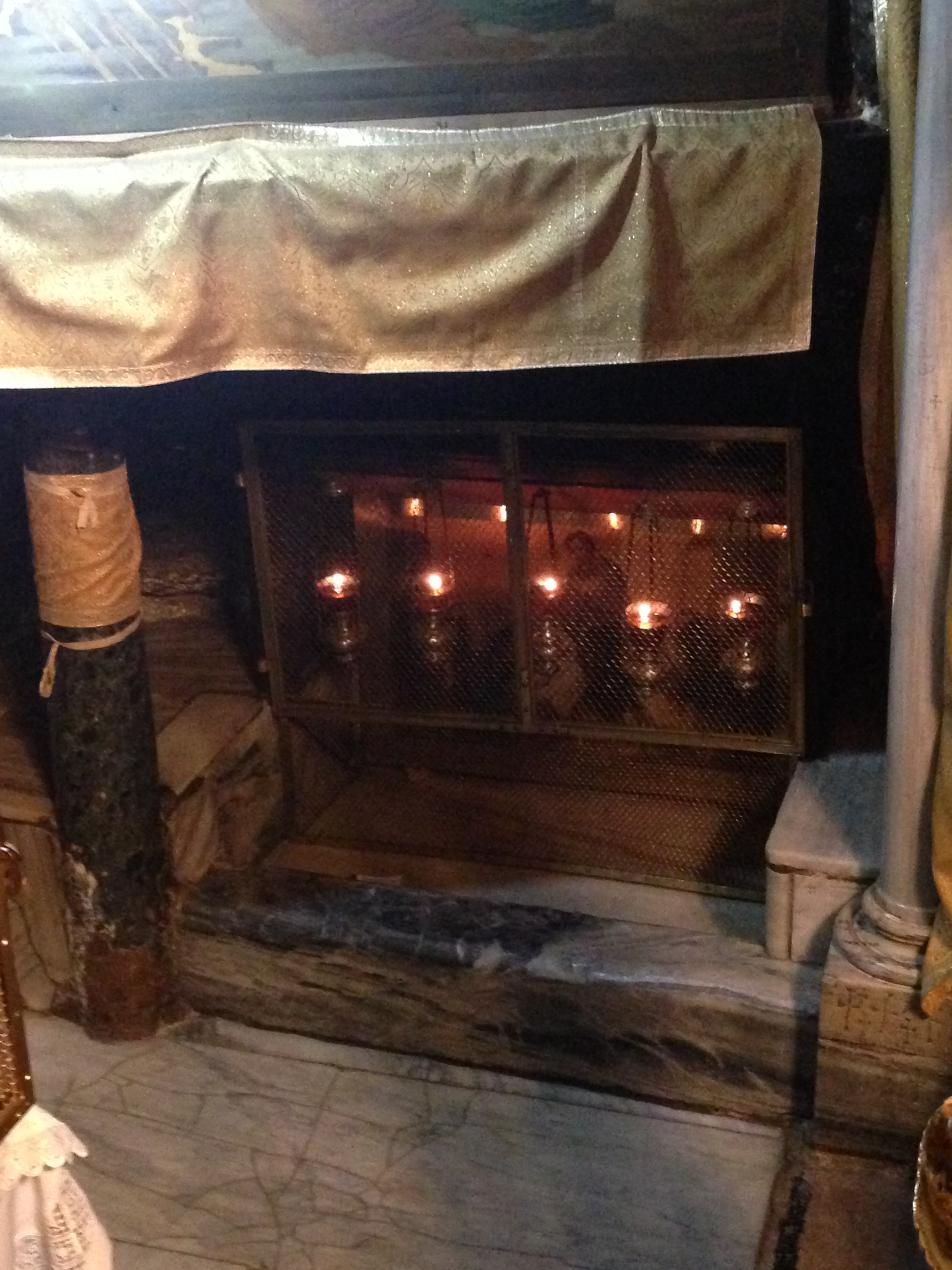
I’m not really sure much more needs to be said on this night. Rather, here in this place as others might be rushing out for one last gift or frantically trying to get the kids in bed without peeking at what Santa is going to bring. Tonight we pause for a few minutes to close our eyes and use our imaginations to see if we can see the night when Love was born. . . . We’ve included in our bulletin tonight a few photos I had the great privilege to take this year. Some of you already may have seen the star-gilded site at the Church of the Nativity in Bethlehem where it’s believed Jesus was born. It’s down some steps beneath the massive sanctuary of the Church of the Nativity, in what once was a simple cave where animals were kept safe for the night. As you go down the steps, to the right you see this:
15891113
To the left you see this:
IMG_2268
– Bethlehem’s manger. . . . Most probably the whole place had some hay in it that night instead of marble, gold, and candles all around. In Bethlehem they tell you that it wasn’t that the inn was too crowded. Rather, as the scripture too alludes, there was no place for them (Luke 2:7). For you see, with how full the inn must have been, for Mary to go inside to give birth would have made the whole lot of them ritually unclean. The cave for the animals out back is offered because they already were unclean. Creation is left to cradle the newborn King. It freely sings its praise to God, while we humans let our stuff get in the way. . . . And so it goes that from the start, Love is going to bump up against law. Grace is in conflict with religious shoulds from the very moment he is born into this world.

Maybe it’s not quite the spot you’ve imagined all your life – it wasn’t when I saw it in person either. And some may wonder if it even took place right there. Nonetheless, it is the spot where millions of pilgrims travel every year just for one brief moment to bend in adoration. It really is incredibly overwhelming . . . to see the night when Love was born.

You know, they might as well have named him that: capital L, o, v, e:  Love. For the Holy One willingly taking on the clothes of our flesh and blood is love itself. It’s the message the angels are trying to tell the shepherds: this birth shows definitely the deep, deep favor of God to all. Great news of goodwill! The depths of God’s love for this entire creation that God would become one of us to be our way, our truth, the very path for us to Life here and now and forevermore. . . . Ah: what a marvelous, marvelous night!

For a few moments in the quiet now, I invite you to close your eyes. Imagine in your mind’s eye. See the night when Love was born . . .

Amen.

© Copyright JMN – 2014  (All rights reserved.)

Christmas Story #2

DISCLAIMER: I believe sermons are meant to be heard. They are the word proclaimed in a live exchange between God and the preacher, and the preacher and God, and the preacher and the people, and the people and the preacher, and the people and God, and God and the people. Typically set in the context of worship and always following the reading of scripture, sermons are about listening and speaking and hearing and heeding. At the risk of stepping outside such boundaries, I share sermons here — where the reader will have to wade through a manuscript that was created to be spoken word. Even if you don’t know the sound of my voice, let yourself hear as you read. Let your mind see as you hear. Let your life be opened to whatever response you begin to hear within you.

May the Spirit Speak to you!
RevJule
______________________

21 December 2014 – 4th Sunday of Advent

Luke 1:1-2:40 (included below)

Two weeks ago we heard Christmas Story #1 as told according to the gospel of Matthew and today we’re on to Christmas Story #2: the telling of it all according to the gospel of Luke. While Christmas Story #1 in Matthew begins with that lengthy genealogy of who fathered who from the great father Abraham, to King David, through the deportation to Babylon, and all the way to Joseph, the husband of Mary who gave birth to Jesus, the Christ; at the same time, the gospel of Luke has its own very unique way of beginning to tell of the good news of God coming to live in Jesus as one of us. Listen for God’s word to us in the opening of the gospel of Luke:

“Since many have undertaken to set down an orderly account of the events that have been fulfilled among us, 2 just as they were handed on to us by those who from the beginning were eyewitnesses and servants of the word, 3 I too decided, after investigating everything carefully from the very first, to write an orderly account for you, most excellent Theophilus, 4 so that you may know the truth concerning the things about which you have been instructed.”

It’s probably important that we know that the gospel of Luke was composed somewhere around 80-90 CE. In other words, some 50-60 years after Jesus’ death and resurrection. . . . One thing jumps out in this introduction: the one for whom this gospel is written. Theo-philus. While our English versions capitalize the word as if it is a name, history has not proven the existence of one named Theophilus, whom the gospel of Luke sought to address. Theo-philus. Theo, meaning God in Greek. And philus coming from one of the Greek words translated love – like the kind of love between friends or brothers. We know it best in Philadelphia, the City of Brotherly Love. So: Theo-philus: God-lover. That’s the one to whom Christmas Story #2 is written: the beloved of God who themselves love God. In other words, regular people like you and me: the faithful who are seeking to love God more. It’s a very different way to begin a gospel and in fact, it seems Luke goes on to tell story after story of God-lovers who ended up knowing more of their beloved status, even as they fall more deeply in love with God – something hoped for everyone who hears this gospel. Listen to the likes of those who will be a part of this telling of Christ’s birth – not terrified Kings and outside seekers, as is emphasized in the gospel of Matthew. Rather lover-of-God after lover-of-God who behold this marvelous birth! Listen – especially to the parts of this story that rarely get read this time of the year:

5 “In the days of King Herod of Judea, there was a priest named Zechariah, who belonged to the priestly order of Abijah. His wife was a descendant of Aaron, and her name was Elizabeth. 6 Both of them were righteous before God, living blamelessly according to all the commandments and regulations of the Lord. 7 But they had no children, because Elizabeth was barren, and both were getting on in years. 8 Once when he was serving as priest before God and his section was on duty, 9 Zechariah was chosen by lot, according to the custom of the priesthood, to enter the sanctuary of the Lord and offer incense. 10 Now at the time of the incense offering, the whole assembly of the people was praying outside. 11 Then there appeared to him an angel of the Lord, standing at the right side of the altar of incense. 12 When Zechariah saw him, he was terrified; and fear overwhelmed him. 13 But the angel said to him, “Do not be afraid, Zechariah, for your prayer has been heard. Your wife Elizabeth will bear you a son, and you will name him John. 14 You will have joy and gladness, and many will rejoice at his birth, 15 for he will be great in the sight of the Lord. He must never drink wine or strong drink; (for) even before his birth he will be filled with the Holy Spirit. 16 He will turn many of the people of Israel to the Lord their God. 17 With the spirit and power of Elijah he will go before him, to turn the hearts of parents to their children, and the disobedient to the wisdom of the righteous, to make ready a people prepared for the Lord.” 18 Zechariah said to the angel, “How will I know that this is so? For I am an old man, and my wife is getting on in years.” 19 The angel replied, “I am Gabriel. I stand in the presence of God, and I have been sent to speak to you and to bring you this good news. 20 But now, because you did not believe my words, which will be fulfilled in their time, you will become mute, unable to speak, until the day these things occur.” 21 Meanwhile the people were waiting for Zechariah, and wondered at his delay in the sanctuary. 22 When he did come out, he could not speak to them, and they realized that he had seen a vision in the sanctuary. He kept motioning to them and remained unable to speak. 23 When his time of service was ended, he went to his home. 24 After those days his wife Elizabeth conceived, and for five months she remained in seclusion. She said, 25 “This is what the Lord has done for me when he looked favorably on me and took away the disgrace I have endured among my people.”

Here we have Luke’s first God-lovers: Two righteous people. A priest of Israel, no less, and his barren wife who just so happens to be a descendant of Israel’s first priest, Aaron. According to the gospel of Luke, Zechariah and Elizabeth are “living blamelessly according to all the commandments and regulations of the Lord” (Luke 1:6). And, at long last – like Sarah and father Abraham before them; like Hannah and her husband Elkanah – their prayers are answered. Too long have they born the shame of being childless among a people who believed your children gave witness to your favored status in the LORD’s eyes. After they’ve given up all hope on account of their old age, these two will be the parents of the one who will get everyone else ready for Jesus. It’s remarkable the way these God-lovers went about their duties. We have to wonder from Zechariah’s reaction if he was expecting much when the lot fell to him to go in and perform the incense offering. Because you see, the ironic thing is that the incense offering he was to carry out was the offering (according to Exodus) that God first commanded Aaron to perform on the altar in the place before the arc of the covenant and the mercy seat where God promised to meet with them (Exodus 30:1-10). It kinda begs the question if we too might be going through the motions. Going through the motions of weekly worship. Going through the motions of our daily prayers. Even going through the motions of these Advent weeks not really expecting God to show up. Though it seemed he no longer anticipated it, Zechariah was in for the most stupendous encounter with God that day as he went through the motions of his priestly duties. . . . It’s one of the beautiful messages of the gospel of Luke’s telling of Christ’s birth. Right after we hear of Zechariah and Elizabeth, Luke races into the next part of the story, which we all certainly know well: 26 “In the sixth month the angel Gabriel was sent by God to a town in Galilee called Nazareth, 27 to a virgin engaged to a man whose name was Joseph, of the house of David. The virgin’s name was Mary. 28 And he came to her and said, “Greetings, favored one! The Lord is with you.”

From an elderly man to a young girl not yet a woman, God tears into the ordinary to say: “Greetings! I am about to do something remarkable! And, o, by the way: I need YOU in order to accomplish it!” Like it or not, it’s the way God chooses to work: through God’s people. The conversations between the messenger and Zechariah, and the messenger and Mary go almost exactly alike. Both, in fact, question how this can be. Zechariah will be turned mute for a while in order to finally understand. Perhaps to emphasis that sometimes we do far too much talking to God. How many of us don’t hem and haw around – offering all sorts of excellent excuses why we really can’t be the one to accomplish whatever it might be God wants to accomplish through us. Zechariah’s a good reminder that we need to be quiet to listen and then act. And what of Mary? I read a legend this week that offered the explanation that “Mary was not the first person asked to be the God-bearer, but rather she was the first person to say yes” (Feasting on the Gospels – Luke, Vol. 1; Luke 1:26-38, James R. Luke Jr.). We might not like that idea; perhaps because it strikes a little bit too close to home. Because, as one preacher has said: “What good is it to me if this eternal birth of the divine son takes places unceasingly but does not take place within me? And what good is it to me if Mary is full of grace, if I am not also full of grace?” (Barbara Brown Taylor, ????????) Isn’t it true that we each are the tabernacles, or containers, of the holy – God, in the Holy Spirit, living in us? Which also makes us “pregnant with divine possibilities” in order for God to give birth to what’s needed in our own time (Feasting on the Gospels – Luke, Vol. 1; Luke 1:26-38, James R. Luke Jr.). Mary: the God-bearer, and you and me likewise. Opening our lives to say: “Here we are, God, your daily servants. Let it be according to your desire!”

We’ve already heard this morning the song Mary sings when she joins Elizabeth. Picture those twin round bellies: two willing women, miraculously playing their part in God’s great plan to definitively show the world God’s goodwill towards all! What soul wouldn’t want to rejoice?! Luke moves from that beautiful song of Mary almost immediately into another one. After John’s birth and naming, his father’s tongue sings its second set of first words. Listen:

67 Then his father Zechariah was filled with the Holy Spirit and spoke this prophecy: 68 “Blessed be the Lord God of Israel, for he has looked favorably on his people and redeemed them. 69 He has raised up a mighty savior for us in the house of his servant David, 70 as he spoke through the mouth of his holy prophets from of old, 71 that we would be saved from our enemies and from the hand of all who hate us. 72 Thus God has shown the mercy promised to our ancestors, and has remembered his holy covenant, 73 the oath that he swore to our ancestor Abraham, to grant us 74 that we, being rescued from the hands of our enemies, might serve the LORD without fear, 75 in holiness and righteousness before him all our days. 76 And you, (my) child (John), will be called the prophet of the Most High; for you will go before the Lord to prepare his ways, 77 to give knowledge of salvation to his people by the forgiveness of their sins. 78 By the tender mercy of our God, the dawn from on high will break upon us, 79 to give light to those who sit in darkness and in the shadow of death, to guide our feet into the way of peace.”

Angels are going to announce almost the exact same thing at the next birth. And in the gospel of Luke, shepherds are the ones who come running to see: another set of characters Luke lifts up in order to set up the theme, as one commentator has said that: “The main actors in this drama will not be the rich and the powerful but, rather, those overlooked by the world. . . . barren older couples, unwed teenage mothers, and those relegated to caring for animals. The good news is that even they play a part in this drama of salvation. (Which means that) The terrifying news . . . is that even we (must) play a part in this drama of hope” (Feasting on the Gospels – Luke, Vol. 1; Luke 1:5-25, James R. Luke Jr.). But we’ll get to more of that on Christmas Eve!

The gospel of Luke picks up after all the details of that most holy of nights, with eight days later. In Israel faithful God-lovers were waiting and watching. When at last the holy child shows up for his first time in the Temple of Jerusalem, he’s taken from his mother’s arms as one looking forward to the dawning of Israel’s hope proclaims: 29 “Master, now you are dismissing your servant in peace, according to your word; 30 for my eyes have seen your salvation, 31 which you have prepared in the presence of all peoples, 32 a light for revelation to the Gentiles and for glory to your people Israel.” 33 The child’s father (Joseph) and mother (Mary) were amazed at what was being said about him. 34 Then Simeon blessed them and said to his mother Mary, “This child is destined for the falling and the rising of many in Israel, and to be a sign that will be opposed 35 so that the inner thoughts of many will be revealed—and a sword will pierce your own soul too.”

Imagine how much that must have hurt the heart of this new mother. He’s not even old enough yet to have gotten to that baby smiling stage when Mary is given a peek into what the future will be for her Son of the Most High, the One who will reign over the house of Jacob forever, whose kingdom shall have no end. How could she have known his miraculous birth would lead to a torturous death that would test her trust in the God for whom that messenger said nothing would be impossible? We can only hope that she can treasure these initial moments in her soul long enough to keep faith throughout all the days of his life, death, and God’s biggest surprise yet to come. It’s like the writer of Luke wants to get us ready from the start. To point out all the details of this amazing in-breaking of God in our world so that we won’t lose hope on the days when hope is not present. There will be days in this life when we will need to cling ever so tightly to the pronouncements made at this birth. For the darkness still surrounds.

The last lover of God to take the stage in Christmas Story #2 knew it well. Listen: 36 “There was also a prophet, Anna the daughter of Phanuel, of the tribe of Asher. She was of a great age, having lived with her husband seven years after her marriage, 37 then as a widow to the age of eighty-four. She never left the temple but worshiped there with fasting and prayer night and day. 38 At that moment (when the Holy Family was there with Simeon) she came, and began to praise God and to speak about the child to all who were looking for the redemption of Jerusalem.” (She’s one of the first to fulfill that command as she tells it on Zion’s mount.) Finally Luke records: 39 “When (the Holy Family) had finished everything required by the law of the LORD, they returned to Galilee, to their own town of Nazareth. 40 The child grew and became strong, filled with wisdom; and the favor of God was upon him.”

And so the drama of his life begins – though only that situation in the Temple at the age of his bar mitzvah (12 years old) will be mentioned between his birth and his baptism by John in the Jordan at 30 years of age. . . . With the regular God-lovers of the gospel of Luke’s Christmas Story, we’re invited to fall a little bit deeper in love with the God for whom nothing will be impossible – the God who seeks to ensure that everyone knows God’s favor rests upon us all. Peace is possible; for in Christ’s birth, we no longer have to wonder whether the Sovereign Maker of the universe hears our cries. We no longer have to get in line behind those of the world who think they matter more than any others. Our lives can be filled with the God-of-all-possibility’s hope! . . . Its mighty good news, most excellent God-lovers! Mighty good news! May it prepare our souls too to rejoice!

In the name of the life-giving Father, the life-redeeming Son, and the life-sustaining Spirit, Amen!

© Copyright JMN, 2014  (All rights reserved.)

Christmas Story #1

DISCLAIMER: I believe sermons are meant to be heard. They are the word proclaimed in a live exchange between God and the preacher, and the preacher and God, and the preacher and the people, and the people and the preacher, and the people and God, and God and the people. Typically set in the context of worship and always following the reading of scripture, sermons are about listening and speaking and hearing and heeding. At the risk of stepping outside such boundaries, I share sermons here — where the reader will have to wade through a manuscript that was created to be spoken word. Even if you don’t know the sound of my voice, let yourself hear as you read. Let your mind see as you hear. Let your life be opened to whatever response you begin to hear within you.

May the Spirit Speak to you!
RevJule
______________________

7 December 2014 – 2nd Sunday of Advent
Matthew 1:1-2:23 (included below)

Ordinarily the second Sunday of Advent finds us focusing on John the Baptist. The one crying out in the wilderness in his camel’s hair with his locusts dipped in wild honey. We hear him tell to get ready! Prepare for the coming of the One who will baptize you with the power of the Holy Spirit. Who will make you ready to live the kingdom of God each day! That’s what the second Sunday of Advent typically is about. And in year B of the lectionary, which we just entered last week, it’s always from the gospel of Mark. Which oddly enough is how Mark starts the good news of Jesus Christ, the Son of God. In his gospel, we don’t hear of angel annunciations or dreams to keep Mary. No shepherds or wise men or cattle a-lowing in the meager manger stall of Bethlehem. John the Baptist crying out in the wilderness to prepare for the way of the Lord is how the gospel of Mark begins; then jumps right into the full-grown Jesus showing up himself to get baptized by John.

Well, a little different Advent path calls this year. It seems the old story might speak to us anew if we approached it from another angle. O, I know that we have our nativity set up in full on the organ. All the beloved pieces already are there – the baby in the feed-trough, Mary and Joseph, the shepherd and wise men, and even a few beasts of the field. It’s all there mushed up together because that’s the way we know the story – all the components of it that we absolutely cherish. But for the next few weeks of this season, we’re going to do our best to pull them apart. See if we can’t hear a fresh message this go around if we listen to how each gospel uniquely tells of the story of Christ’s birth.

As I already said, we won’t have one from the gospel of Mark. We’ll hear from Matthew today and do our best to hold at bay the surprise of the young Mary when the angel comes to her. The trek to Bethlehem. And even the blessed details of that holy night of his birth. We’ll get to that in a few weeks. And even consider the very different way the gospel of John, with that pre-existent Word, tells how Christ came to be. But for now: Matthew. Let’s see if we can hear it as this writer told, so that maybe, just maybe our hearts and minds will be a bit more prepared to celebrate the most amazing gift of God-in-flesh, Emmanuel. Listen now for God’s word to us regarding the coming of Christ, our Lord, according to the unique telling in the gospel of Matthew. And know that this opening part is filled with a whole bunch of names – some of which may stand out to us immediately and some of which we may not know at all – some of which I may not even pronounce very well. Matthew’s first audience, being Jewish, of course would have recognized and known the story of each one. They would have noted the names that are missing and known the details of the women pointed out in this paternal genealogy which typically would list just the fathers; all of which make one wonder just what the writer of Matthew was up to. Listen:

“An account of the genealogy of Jesus the Messiah, the son of David, the son of Abraham. 2 Abraham was the father of Isaac, and Isaac the father of Jacob, and Jacob the father of Judah and his brothers, 3 and Judah the father of Perez and Zerah by Tamar, and Perez the father of Hezron, and Hezron the father of Aram, 4 and Aram the father of Aminadab, and Aminadab the father of Nahshon, and Nahshon the father of Salmon, 5 and Salmon the father of Boaz by Rahab, and Boaz the father of Obed by Ruth, and Obed the father of Jesse, 6 and Jesse the father of King David. And David was the father of Solomon by the wife of Uriah, 7 and Solomon the father of Rehoboam, and Rehoboam the father of Abijah, and Abijah the father of Asaph, 8 and Asaph the father of Jehoshaphat, and Jehoshaphat the father of Joram, and Joram the father of Uzziah, 9 and Uzziah the father of Jotham, and Jotham the father of Ahaz, and Ahaz the father of Hezekiah, 10 and Hezekiah the father of Manasseh, and Manasseh the father of Amos, and Amos the father of Josiah, 11 and Josiah the father of Jechoniah and his brothers, at the time of the deportation to Babylon. 12 And after the deportation to Babylon: Jechoniah was the father of Salathiel, and Salathiel the father of Zerubbabel, 13 and Zerubbabel the father of Abiud, and Abiud the father of Eliakim, and Eliakim the father of Azor, 14 and Azor the father of Zadok, and Zadok the father of Achim, and Achim the father of Eliud, 15 and Eliud the father of Eleazar, and Eleazar the father of Matthan, and Matthan the father of Jacob, 16 and Jacob the father of Joseph the husband of Mary, of whom Jesus was born, who is called the Messiah. 17 So all the generations from Abraham to David are fourteen generations; and from David to the deportation to Babylon, fourteen generations; and from the deportation to Babylon to the Messiah, fourteen generations.” (Matthew 1:1-17).

Ok: just a note here. What an amazing genealogy! If we look back in the biblical records we’d see that it wasn’t quite as rounded out as the gospel writer tells it. But 14 to 14 to 14, or 42 generations from God first coming to father Abraham to God coming in the human clothes of Jesus, the Christ, is kinda cool. Each period is the perfect number 7 times two equaling 14. Many of us can’t trace our own ancestry back much more than 2 or 3 generations. But the writer of the gospel of Matthew wants us to know from the start that this Messiah, this son of David and of Abraham isn’t something new. God long has been working through this human family to arrive at the day when One would appear who would save his people. . . . It’s an impressive list to let us know right away that this One whose story is being told comes from a royal line. Still, there’s some women in there – and some men too – who were not necessarily the most upright. King David’s indiscretion with Bathsheba is mentioned here. As is the foreign woman Ruth who wiggled her way into the story. In fact, all four of the Old Testament women mentioned in this genealogy are foreigners. Righteous king Hezekiah is mentioned right alongside that menacing Manasseh who undid all the good, God-fearing stuff his father had re-started. Not keeping any of the family secrets in the closet here. Even Babylon is mentioned – which still had to sting in the mind of a Jewish listener. Or maybe it was a comforting reminder that like the kingdom of Babylon that fell, Rome – under whom they now were living – would pass away too. All of which is to say that God was breaking into a very human family – not seeking the perfect, spotless lineage by which to come to a hurting world. Rather, recognizing that we humans are far from perfect, which is why we need this baby in the first place. . . . And listen to how it took place, at least according to the gospel of Matthew:

18 “Now the birth of Jesus the Messiah took place in this way. When his mother Mary had been engaged to Joseph, but before they lived together, she was found to be with child from the Holy Spirit. 19 Her husband Joseph, being a righteous man and unwilling to expose her to public disgrace, planned to dismiss her quietly. 20 But just when he had resolved to do this, an angel of the Lord appeared to him in a dream and said, “Joseph, son of David, do not be afraid to take Mary as your wife, for the child conceived in her is from the Holy Spirit. 21 She will bear a son, and you are to name him Jesus, for he will save his people from their sins.” 22 All this took place to fulfill what had been spoken by the Lord through the prophet: 23 “Look, the virgin shall conceive and bear a son, and they shall name him Emmanuel,” which means, “God is with us.” 24 When Joseph awoke from sleep, he did as the angel of the Lord commanded him; he took her as his wife, 25 but had no marital relations with her until she had borne a son; and he named him Jesus.” (An act that engrafted Jesus into Joseph’s biological lineage.)

Indeed, it is Joseph who is the primary actor here – next to God, working through the Holy Spirit to bring this all to be. Right from the start we learn of dreams and prophesies. Five of each will be in the opening part of this gospel’s telling of the story. He’s beginning to set up this Messiah with Moses of old. That was the first time in Israel’s history that they really needed to know God was with them – when they were slaves in Egypt, wondering if they were of any value to anyone. A savior worked for their benefit then; One would be present again. Which they desperately needed. I don’t believe it was any coincidence that this new beginning was taking place at the time in which it was. The writer of Matthew knows his people’s need; for life had grown nearly intolerable with Rome’s configuration of governing. In fact, near the time of Jesus birth, whole villages were being ransacked at the hands of Rome. In 4 CE, Sepphoris – just four miles from Nazareth – was totally destroyed because the Jews were trying to free themselves from the latest kingdom that had conquered them. Jesus of this royal lineage is born, according to the gospel of Matthew, at a particular time and place, under the rule of a particularly harsh king. Listen:

“In the time of King Herod (Rome’s local leader), after Jesus was born in Bethlehem of Judea, wise men from the East came to Jerusalem, 2 asking, “Where is the child who has been born king of the Jews? For we observed his star at its rising, and have come to pay him homage.” 3 When King Herod heard this, he was frightened, and all Jerusalem with him; 4 and calling together all the chief priests and scribes of the people, he inquired of them where the Messiah was to be born. 5 They told him, “In Bethlehem of Judea; for so it has been written by the prophet: 6 “And you, Bethlehem, in the land of Judah, are by no means least among the rulers of Judah; for from you shall come a ruler who is to shepherd my people Israel.'”

We might forget how paranoid this Herod is. He was Rome’s puppet who tried his whole life long to prove to the Jews that he really was one of them – though his lineage was not ethnically pure. He wasn’t born king of the Jews – and presumably he knew of the prophesied Messiah. The gospel of Matthew tells it right from the start that this God-in-flesh is going to be in conflict with the kings of this world. This One’s ways are different. Rome got to peace through victory. This One gets to peace through alternative measures – spelled with the letters l-o-v-e (Marcus J. Borg & John Dominic Crossan, The First Christmas, p. 81; Harper Collins e-books, 2007). Furthermore, this is the Ruler that wants us to know we are not alone; we are with God and God is with us – like a loving shepherd. Not just in terms of physical proximity but also in terms of together – like on one team. God is with us; on our side in this wild ride through the ways of this world. It’s going to be typical for the powers of this world to keep to their old tricks: scheming and scamming. Taking for themselves and turning from the real needs of their people. From the start, the gospel of Matthew sets Herod up as the quintessential example of the ways those who follow God will struggle against. Listen again:

7 “Then Herod secretly called for the wise men and learned from them the exact time when the star had appeared. 8 Then he sent them to Bethlehem, saying, “Go and search diligently for the child; and when you have found him, bring me word so that I may also go and pay him homage.” (Wink, wink.) 9 When they had heard the king, they set out; and there, ahead of them, went the star that they had seen at its rising, until it stopped over the place where the child was. 10 When they saw that the star had stopped, they were overwhelmed with joy. 11 On entering the house, they saw the child with Mary his mother; and they knelt down and paid him homage. Then, opening their treasure chests, they offered him gifts of gold, frankincense, and myrrh. 12 And having been warned in a dream not to return to Herod, they left for their own country by another road. 13 Now after they had left, an angel of the Lord appeared to Joseph in a dream and said, “Get up, take the child and his mother, and flee to Egypt, and remain there until I tell you; for Herod is about to search for the child, to destroy him.” 14 Then Joseph got up, took the child and his mother by night, and went to Egypt, (kinda like a reverse exodus) 15 and remained there until the death of Herod. This was to fulfill what had been spoken by the Lord through the prophet, “Out of Egypt I have called my son.” 16 When Herod saw that he had been tricked by the wise men, he was infuriated, and he sent and killed all the children in and around Bethlehem who were two years old or under, according to the time that he had learned from the wise men. (Kinda like what had happened during the days of Moses’ birth.) 17 Then was fulfilled what had been spoken through the prophet Jeremiah: 18 “A voice was heard in Ramah, wailing and loud lamentation, Rachel weeping for her children; she refused to be consoled, because they are no more.” 19 When Herod died, an angel of the Lord suddenly appeared in a dream to Joseph in Egypt and said, 20 “Get up, take the child and his mother, and go to the land of Israel, for those who were seeking the child’s life are dead.” 21 Then Joseph got up, took the child and his mother, and went to the land of Israel. 22 But when he heard that Archelaus was ruling over Judea in place of his father Herod, he was afraid to go there. And after being warned in a dream, he went away to the district of Galilee (about a 100 miles north of Jerusalem). 23 There he made his home in a town called Nazareth, so that what had been spoken through the prophets might be fulfilled, “He will be called a Nazorean.”

What a contrast in response to this birth. In the midst of the story about a very threatened king, foreign seekers come from the East. Presumably those outside the Jewish family, they still sought Wisdom. They looked in wonder to the natural world – God’s ever-surrounding mouth-piece. Something must have been in them that knew worship. That knew awe. And whether or not they had the right language yet; they must have trusted that a grand Designer was behind it all. The ones from the East are open to the wisdom that surrounds us in creation each day so that they knew to pay attention to a brand new star that was doing something unlike anything they had seen before. They got themselves ready to encounter One worthy to receive their most precious gifts of gold, frankincense, and myrrh. . . . Meanwhile, the current King of the Jews goes stark raving mad. Out of fear of what he might lose, he orders dead all the children around Bethlehem who were younger than two years. This cannot endear the Bethlehemites to him and his rule. But he gives no thought to that. And so continues the long line of violence – even to this very day against the city of Bethlehem; the violence continues which the baby in the manger came to stop. He will grow to show a totally different way of being. One that seems well-exemplified, according to the gospel of Matthew, in the earthly father Joseph. In that long genealogy, we hear of father after father in Joseph’s family – some of whom were great role models for him of how to be the most amazing dad. And wasn’t he?! It wasn’t even his biological son and look what Joseph does. First he believes – he trusts that God is up to something new in the woman he loves. Next, he pays attention to a classic way God gets into our hearts and our minds: he seeks to discern his dreams to know what God wants from him next. Then, more than once, he protects this precious gift given to his care. Such love! Such wisdom! What an amazing father! What a faithful servant of the Savior of the world!

And so the little one is born into this world, according to the unique telling of the gospel of Matthew. We’re given much to ponder about who this baby is who is named from the start the Messiah. We’re encouraged to pay attention too to the dreams God gives us in God’s continuing work to save this world. We’re warned these ways will not be like the ways undertaken for gain among so many in this world. We’re painted three distinct portraits of response to God’s great gift. And we’re left to wonder as we continue our trek to the celebration of his birth: just how might we live as a result of this new life.
May Christmas Story #1, the telling of the tale according to the gospel of Matthew, leave us a bit more prepared to rejoice!

In the name of the life-giving Father, the life-redeeming Son, and the life-sustaining Spirit, Amen.
© Copyright JMN – 2014 (All rights reserved.)

One Life

16 November 2014 sermon — Matthew 25:14-30

DISCLAIMER: I believe sermons are meant to be heard. They are the word proclaimed in a live exchange between God and the preacher, and the preacher and God, and the preacher and the people, and the people and the preacher, and the people and God, and God and the people. Typically set in the context of worship and always following the reading of scripture, sermons are about listening and speaking and hearing and heeding. At the risk of stepping outside such boundaries, I share sermons here — where the reader will have to wade through a manuscript that was created to be spoken word. Even if you don’t know the sound of my voice, let yourself hear as you read. Let your mind see as you hear. Let your life be opened to whatever response you begin to hear within you.

May the Spirit Speak to you!
RevJule
______________________

Click here to read scripture first: Matthew 25:14-30 (NRS)

Several years ago I sat through a long and arduous meeting across from a woman wearing a t-shirt that I couldn’t take my eyes off of. It really was so alarming that I found myself deep in thought rather than paying attention to the agenda for which we were gathered. The t-shirt read: “You have one life. Do something!” . . . “You have one life. Do something!” . . . Wasn’t that the message we heard a few weeks ago on All Saints’ Sunday as the chime rang for each loved one we named? Isn’t that the silver lining of the dark cloud of death? Every time we come face-to-face with the loss of a loved one, at the same time, we come face-to-face with the reality of our limited time. Our days are not infinite – not in the life we know now as human beings. . . . Sure we have the promise and hope of life everlasting with our God. But here and now, we only have one life. It is expected that we do something!

Jesus might as well have been wearing the very same t-shirt as he talked to his disciples that day. Mind you – according to the gospel of Matthew’s telling of the story – these words come just two days before the drama of Christ’s final Passover. They’re in Jerusalem – well, right outside on the Mount of Olives, actually (Mt. 24:3). And certainly at least one of the twelve was intuitive enough to know the tension is mounting. The one who’s been busy giving away his life each day for the life of the world is about to face his riskiest investment yet. He’s about to march right into Jerusalem, and though he doesn’t want to swallow the biter cup of suffering – as his prayer in the garden reveals (Mt. 26:39), still: he’s willing to keep himself open come what may. Even if the outcome is death, he keeps his trust in his father: our God of Life. . . . This one, who is on his own high-risk adventure, is the one who tells the story we heard today as recorded in Matthew’s gospel.

It’s like three people, Jesus says. Maybe we should start it the way we love all stories to start. Once upon a time there was an extravagant owner. He wanted to see how his folks would do. So he called them together and gave to each way more than any could imagine. He was careful to consider what each might be able to handle, so as not to overwhelm. Yet lavish, immense amounts were granted. . . . According to Jesus’ telling of the story, one was given the equivalent of 75 years of a day laborer’s earnings. One 30 years of a day laborer’s earnings. One 15 years of a day laborer’s earnings (Feasting on the Word, Yr. A, Vol. 4; Lindsay P. Armstrong, p. 309). . . . They really weren’t given any instructions. Just entrusted with such enormous gifts. I guess the owner figured they all knew each other really well: out of love for the one freely giving, the three would know just what to do. I mean, love begets love. Generosity evokes additional generosity in open, pure spirits. So, of course, the owner simply trusted they would not squander the gift.

Perhaps the owner forgot that fear is powerful. Fear gets its fangs in us and before we know it, we’re stuck. Immobilized. . . . How often has Spirit come to us with grandiose ideas? Crazy thoughts about things like starting over. Or trying something new. Opening ourselves to the person in need before us. Or investing more of our time and energy that another might grow. Spirit nudges us all the time into the ways that lead to life. And when we’re listening; if we’re paying attention; too often fear gets at us before the new thing even is given a chance to begin. . . . Now what if that would have been Christ’s approach? Where would we be – where would the fate of God’s entire creation be – had Jesus allowed fear to get the better of him that week in Jerusalem as he faced all that lie ahead? . . .

Once upon a time, one who was given an extraordinary amount went out in fear. He dug a hole. Not wanting to lose or waste or take any sort of risk whatsoever with what of his master’s he’d been given; he buried in the ground that which had been entrusted to him. He allowed fear to rob him of the opportunity to know great joy. . . . As one commentator has written, he played it safe, which is “something akin to death, like being banished to the outer darkness” (Feasting on the Word, Yr. A, Vol. 4; John M. Buchanan, p. 312).

We have one life.

Of course, there are other ways to understand this story. There’s always more than one way to understand whatever we hear. One preacher questions why we always relate the master of this parable of Jesus with the big M Master of the Universe. (Barbara Brown Taylor, “The Parable of the Fearful Investor,” Nov. 13, 2011: http://chapel.duke.edu/worship/worship-services/sermons-bulletins/2011-sermons-archive). Reading from another angle, she wonders if this third slave wasn’t the hero of the story. The whistle-blower of sorts who refused to participate in an economic system, like the one of Jesus’ day, that was eating up the simple people of the land while more fully filling the deep pockets of those profiting from the way it had come to be. Might Jesus have meant the master of this parable was a lower-case m master who just was trying to get more for himself in the end – no matter the cost to those hurt by it all. If we read it that way, this parable becomes a code to Christ’s disciples that refusal to participate with the powers that be will lead to the wrath of those powers coming down upon our head. As he’s about to experience in Jerusalem, do something as rash as not perpetuate the unjust system and the system will ensure we are put out. Taken away the little that we might have and thrown out into utter darkness as one totally worthless in a world set up to take more and more for themselves. . . . The truth remains: We have one life. And just wait until we hear the parable Jesus is about to tell next – at least according to the gospel of Matthew! Come back next week for that one.

Maybe you’ve heard the brilliant words of the poet Mary Oliver. In a poem entitled “The Summer Day,” Oliver writes, and I quote: “Who made the world? Who made the swan, and the black bear? Who made the grasshopper? This grasshopper, I mean — the one who has flung herself out of the grass, the one who is eating sugar out of my hand, who is moving her jaws back and forth instead of up and down — who is gazing around with her enormous and complicated eyes. Now she lifts her pale forearms and thoroughly washes her face. Now she snaps her wings open, and floats away.” Oliver writes: “I don’t know exactly what a prayer is. I do know how to pay attention, how to fall down into the grass, how to kneel down in the grass, how to be idle and blessed, how to stroll through the fields, which is what I have been doing all day. Tell me,” she writes, “what else should I have done? Doesn’t everything die at last, and too soon? Tell me, what is it you plan to do with your one wild and precious life?” (Mary Oliver, The House Light Beacon Press Boston, 1990 on: http://www.bemindful.org/poems.htm).

We have one life: one wild and precious life. An amazing gift to us from God.

One thing we might commit to do is invest a little bit more of it in the mission of God. If you were here last week then you might have heard the Minute for Mission in which one member said that she gives of her time, talents, and money because she wants to be a part of this church. She wants to be involved in the ministry this church is doing – things that she knows matter to God even more than they matter to her. . . . Many of you already are investing in God’s work through this church by participating in bible studies and Sunday School and other opportunities to shape your heart and mind a little bit more into the heart and mind of God. Some of you are around here a lot: fixing what’s broken, listening to the need of a struggling stranger, welcoming whoever enters into our fellowship hall or food bank or sanctuary. Most all of you are giving financial offerings each week that go to pay the electric bills of this church, and ensure we are inspired by beautiful music, and even have a pastor to call upon when you need someone to help you sort through what God is up to in your life. I wonder if each of us could step up a little bit more. Maybe increase our financial pledge by just one small percent in the year ahead. So that if you have been giving $2,000 this year, increase it one percent to $2,020 in 2015 – that wouldn’t be too harsh of a stretch for most of us, would it? If you only have been attending worship, try getting involved in one additional ministry of the church – not necessarily to be in charge of it, but maybe just show up to be present next year in one more way. If you have been great among us at using your talent of organizing, maybe begin to utilize your talent of encouragement too. You get the idea. What if every one of us invested a little bit more of who we are and what we have for the work of God through the ministry of this church? . . . We only have one life: one wild and precious life.

So: hide it? We cannot. Play it safe? We cannot. Risk it all, invest it lavishly like our Lord, in absolute trust of the abundantly, Life-giving Master? I know it may not sound very prudent – or even very Presbyterian. Nonetheless, here and now, we’ve got just one wonderful life. . . . For the life of the world, why not risk it all? In the end we too might hear: “Well done good and faithful servant! . . . Enter into the joy of your extravagant master!” (Mt. 25:21).

In the name of the life-giving Father, the life-redeeming Son, the life-sustaining Spirit, Amen.

© Copyright JMN – 2014 (All rights reserved.)

2 November 2014 Sermon — All Saints’ Sunday

The Saints of our Lives

DISCLAIMER: I believe sermons are meant to be heard. They are the word proclaimed in a live exchange between God and the preacher, and the preacher and God, and the preacher and the people, and the people and the preacher, and the people and God, and God and the people. Typically set in the context of worship and always following the reading of scripture, sermons are about listening and speaking and hearing and heeding. At the risk of stepping outside such boundaries, I share sermons here — where the reader will have to wade through a manuscript that was created to be spoken word. Even if you don’t know the sound of my voice, let yourself hear as you read. Let your mind see as you hear. Let your life be opened to whatever response you begin to hear within you.

May the Spirit Speak to you!
RevJule
______________________

2 November 2014 – All Saints’ Sunday
Hebrews 11 (various verses) — 12:1

Click here to read scripture first: Hebrews 11 (NRS)
Hebrews 12:1 (NRS)

I wish we could be in a great big circle today. We could sit with each other to swop stories of the saints of our lives. . . . I know it’s important for us to be familiar with the giants of the church. Those saints like Francis of Assisi. What a remarkable man! Son of a wealthy Italian cloth merchant, Francis spent the early days of his youth living it up. He always was the center of the party and really wanted nothing more than to win himself glory as a valiant knight. At the age of 25, he finally set off on the Fourth Crusade of the early Thirteenth Century. But he never made it. After a days’ journey, Francis had a dream in which God told him he had it all wrong. This wasn’t the purpose of his life. He was to return home immediately. . . . Little by little Francis took to prayer. There are stories of him kissing the hand of a leper, which he later considered to be a test from God. And selling his father’s cloth to rebuild an ancient nearby church, only to end up denouncing his son-ship and hefty inheritance. Instead Francis took to living simply. Begging for garbage to eat, preaching about returning to God, and literally giving away anything he and his growing followers had. This is the Francis who is rumored to have preached to hundreds of birds about being thankful to God for their beautiful cloths – with not one of his listeners flying away until his sermon was all done. Francis considered all of creation a part of God’s family. He even intervened between a village and a wolf that had been killing villagers. Convincing the wolf not to kill again, Francis turned around the fear of the villagers by teaching them how to feed and tend the wolf so that they began to live alongside one another in peace. He is a remarkable saint of the church who even went to Syria on the Fifth Crusade to ask the Muslim sultan to stop the fighting. Known as the founder of the Franciscan Order, he gladly gave up his position of leadership to live out his final days as a regular ole’ brother alongside the others. Dying at just 45 years of age, Francis grew more in his faithfulness in just twenty years as a Christian than many do in an entire lifetime. He’s a great saint of the church who’s witness can inspire us to the joy of simpler living in union with God and all God’s creation (www.catholic.org/saints/saint.php?saint_id=50).

Many of us probably know a bit about Mother Teresa of Calcutta: the Roman Catholic sister of the 20th Century who set off from her home in Albania to India. Eventually she founded the Missionaries of Charity among one of the poorest urban populations of the world. There she and fellow sisters compassionately cared for lepers and other medical outcasts despite any risks to their own health. She tended the wounds of the dying and was a kind of a moral compass throughout her lifetime. She urged us all to follow the voice of Jesus to serve the poor, a message she heard early in her life during a time of prayer. She’s on her way to official sainthood in the Roman Catholic Church.

Another one is the remarkable Saint Hildegard of Bingen, the German mystic of the late Eleventh and early Twelfth Centuries. She was a woman way ahead of her time as she not only was an abbess for a Benedictine order of sisters, but was a remarkable poet, composer, artist, scientist, biblical exegete, writer, preacher, herbalist, and more. Her lectures on the spiritual life are said to have drawn large crowds of listeners from all over Europe. Throughout her long life she experienced these remarkable visions – or times of deep union with God. In fact, it’s said that her family witnessed her in such experiences when she was as young as three years old; and by five, she was aware that these visions were of God. Another deep lover of God’s entire world, a great gift from Hildegard’s wisdom is veriditas. Veriditas is the understanding of the greening of all creation. Something like the life-force of God living in it and us all (www.greenflame.org). She often called it the green flame of God’s Spirit. In 2012, Pope Benedict XVI (16th) named Hildegard a doctor of the church – a designation given in the Roman Catholic Church to those believed to have contributed significantly to the theology of the church – a distinction only 4 women in all of history have obtained (www.catholic.org/saints/saint.php?saint_id=3777). Indeed Hildegard is an incredible saint of the church!

But today isn’t just about those giants – the Francises and Teresas and Hildegards of the faith. For Protestants especially, All Saints’ Sunday is about the regular ole’ faithful folks of our lives. Those who have lived among us to witness directly unto us. . . . If we got together today in that big circle to swop tales of our saints, I wonder how many of us would tell of grandmothers who lovingly told us the stories of Jesus. Or grandfathers who first taught us how to pray. Who of us could speak of fathers or mothers who tenderly held us in their arms as they brought us forth for the sacrament of baptism; then took us home to teach us how to live out Christ’s love each day in our families, neighborhoods, and world. I’ve heard some of you talk about dear friends – of the church or otherwise. People who really went above and beyond the call of duty to be with you in your times of great difficulty. And those who taught you how to celebrate your successes. For some it’s been spouses or siblings or children who have loved you as unconditionally as God. Mentors on the journey in Sunday School classrooms or committee meetings or mission projects. Take a moment right now to call them to mind: those saints of your life who showed you the way of Christ in all the covert and overt ways the saints of our lives do so. Bring their faces to your mind. Remember them now in the quiet of your hearts. Go ahead. I’ll wait for them all to come flooding to your memory.  . . .

Jim W. might be one of them for some of you. His tenure among this congregation goes back many years. I’ve been told Jim loved being a deacon: caring for those in need. A World War II vet, Jim became a traveling salesman and absolutely loved meeting people. When he wasn’t enjoying life among people, Jim was busy bringing beauty to this world by getting down there in the dirt – willing things to grow in his yard at home or out here on the church grounds.

Others of you might be remembering Betty E. Betty had been retired for something like 30 years, but she still talked like it was yesterday about the students she taught in one of the rougher neighborhoods of Nashville. Every day for so many years she went not just to teach the subject matter of a certain grade. She went to give possibility to classrooms full of children who had all the racial and economic strikes against them.

Melissa M. was a daughter of this church; one some knew only by sight. Remember how she devotedly cared for her mother? Some of you remember celebrating life with her and her father in serious games of cards. Melissa gave so much care to so many people – her parents and husband and children and grandchildren. She was a great sister to her brother too. She’s a saint of the church who was grateful for God’s shepherding and joyous about Christ’s birth in this world!

Some of you fondly remember Fred W. Life-long Presbyterian, Fred sought out this church when he and his wife retired to Nashville from North Carolina. He was a faithful servant – even in his aging years. He gave of his time and of the wisdom of his business experience to be a part of our session. He continued to want to learn and found a home among you in Sunday School and in worship.

These are just a few ways those of this congregation who have died this past year have lived out their Christian discipleship. They have witnessed to us and to the world of God’s great love for all. They may never have done the kinds of stuff that would get recorded in a letter like that of Hebrews. That like Abraham and Moses and Rahab. Or, for the sake of God, those who were tortured and mocked and wandering in deserts. That might not be the story of anyone of the saints of this church. It probably won’t be the story of any one of our lives either. Which actually is just fine. Because all that really matters is that each disciple of Christ seeks to follow according to the gifts of who we are. How God made each one of us to be.

Spurred on by the witness of all the saints, in great gratitude; let us run the race set before each one of us. Let us become the saints of others’ lives.

In the name of the life-giving Father, the life-redeeming Son, and the life-sustaining Spirit, Amen.

© Copyright JMN – 2014  (All rights reserved.)
26 October 2014 sermon — Matthew 22:34-40

One Consistent Thing
DISCLAIMER: I believe sermons are meant to be heard. They are the word proclaimed in a live exchange between God and the preacher, and the preacher and God, and the preacher and the people, and the people and the preacher, and the people and God, and God and the people. Typically set in the context of worship and always following the reading of scripture, sermons are about listening and speaking and hearing and heeding. At the risk of stepping outside such boundaries, I share sermons here — where the reader will have to wade through a manuscript that was created to be spoken word. Even if you don’t know the sound of my voice, let yourself hear as you read. Let your mind see as you hear. Let your life be opened to whatever response you begin to hear within you.

May the Spirit Speak to you!
RevJule
______________________

26 October 2014 – Reformation Sunday

Click here to read the scripture first: Matthew 22:34-40 (NRS)

 Here we are: Reformation Sunday 2014. 497 years after Martin Luther posted his 95 Theses on the door to All Saints Cathedral in Wittenberg, Germany. You probably remember that he intentionally did that on October 31, 1517: All Hallows Eve – as he knew every faithful follower would be at the mass for the high holy day on November 1 in honor of All the Saints. Though he didn’t realize it at the time, as he pounded his points for discussion on that great big sanctuary door, he was beginning what became one of the most radical changes in the Christian Church of the West.

Things had come a long way since the start on Pentecost, year 33 of the Common Era. Back then, the first followers of the way had nothing but a commission and the Spirit of God pulsing through their veins. To Jerusalem, all Judea and Samaria, even to the ends of the earth they were to go as witnesses of the good news of God’s unfailing love (Acts 1:8). We can read in the New Testament all about those first tenuous years as Christ’s disciples faced various challenges. Initially, they did their best to remain faithful Jews. They would go about life as usual, but had to figure out how to reconcile this new experience they were staking their lives upon in the life, death, and resurrection of one they came to call the Christ – the long-awaited Messiah of the Jewish nation and all the world. Acts of the Apostles tells how those who remained in Jerusalem and those who went far out clashed with one another as they were working it all out: who’s in, who’s out, and how. Major change was taking place in their worldviews as they came to understand more deeply that this work of God in Christ Jesus was good news for all – not just those of direct Abraham descent.

Once the Jerusalem Temple was destroyed in 70 CE, things got tougher. Remaining Jews and emerging Christians sought to self-define over and against each other. Tensions were high as little by little those who followed Jesus as Lord found new ways to gather – in each other’s homes at first until the state would allow buildings to be built for what we often call churches. A very different mark came to signify one’s inclusion in the group: baptism with water in the name of the Father, Son, and Holy Spirit. The rite of partaking together around table was key as a remembrance of the same self-giving love expected of them. Not an easy path to tread with Rome still oppressing them all.

By the end of the First Century and the beginning of the next, those wanting to join as followers of the Way underwent intense guidance. A mentor who had been at it longer was assigned to walk with each would-be convert. Sorta like an AA sponsor – one that could be called upon at all hours as the person who was seeking to give their total life to the mission of Christ their Lord felt that they might be slipping. In the early house churches, this intense period took place for about a year – or more if needed – before the seeker was allowed to be baptized and finally join the rest of the community at the table for the bread and the fruit of the vine. In those days before Christianity became the official religion of the Roman Empire, followers of Christ’s Way literally were dying to their previous lives and putting on a totally new life in Christ. Some leaving behind families, and all of them beginning to live counter to the ways of the world in order to be a part of a new communion in Christ. Persecution was typical and commitment to this newly unfolding movement needed a serious time of preparation, not to mention daily reinforcement with one another in the morning and again at night for them successfully to be about Christ’s self-giving love for the sake of a better world. . . . It’s a long and sorted story of how we got from those early days of the church to what we had become in the West in Luther’s Sixteenth Century. Lots and lots of changes took place through the centuries – some of them for the better, some not so much – until it came time for a pretty substantial reform.

It’s important for us to remember our history – for we’re just a small part of the stream of God’s Church for the world. I know it can be hard to wrap our minds around days when the bible could not be read by anyone other than a theologically educated clergyman. I can’t imagine gathering each week for worship in those grand cathedrals of old Europe. Hopefully the architecture could speak to you of the marvelous grace of the Creator, Redeemer, and Sustainer; because the words you’d hear there were not of your own tongue. Try keeping off Candy Crush the whole length of those services while the priest literally rattled along in a language you could not understand. Changes indeed were needed if God’s people were going to remain God’s vibrant apostles for the world – sent out to live the ways of Christ with the Holy Spirit of God pulsing through the veins of their bodies. . . . And so in the Sixteenth and Seventeenth Centuries we get bibles in the language common to the people. The first Sunday Schools for lay people to learn what was in those books. A revival of Spirit in some ways as those who worshipped faithfully every week of their lives finally came to know the good news of God’s grace for us all.

I love what one Lutheran pastor published about the Reformation this week: “On Sunday, October 26 we . . . will gather to remember that while the Reformation may have begun with Martin Luther, it certainly did not end with him. The Reformation continues in the work of (God’s) people to reshape and reform our world to be the place God originally intended it to be. This is done through worship, the study of Scripture, and prayer, certainly. But it also is done in the many ways we as the church work to reach out to a struggling world” in service; in love to those in need. The pastor goes on to write: “We welcome all people to join us in the continued reformation of the church and the world. You may not be seeking to change the world, but take an example from Martin Luther. You never know what God has in store for you” (by Derek Fossey, Pastor of Memorial Lutheran Church in Afton; on: stillwatergazette.com/2014/10/17/oct-31-also-celebrates-martin-luthers-reformation/).

Good words. Because the church of Jesus Christ has taken many shapes and so many different forms throughout the centuries. It will continue to do so in all the years to come. We cannot know today what re-forms will be needed tomorrow. How God will work to ensure that God’s church remains relevant to a world that still needs to hear. Open to the new ways God wants us to understand, and be, and put into action for the sake of the good news of Jesus the Christ. God’s church never looks the same in any place from one year to the next. But the most amazing news is that one thing remains consistent. It’s the one thing Jesus proclaimed so very long ago. As the folks came to question him about the law that was the greatest. In other words, the one thing that had to remain consistent. He told them the ancient, two-fold command he’d read about in Deuteronomy and Leviticus. The undisputable ways of God he’d come to know in the marrow of his holy bones. No matter the shape, whatever the form of God’s Church in this world. The one consistent thing is that we always be about the love of God with our whole heart, soul, and mind AND the love of our neighbors as ourselves. As long as the church of Jesus Christ keeps to these, it won’t matter one bit what we look like, where we worship, or how. Everything hangs on this one consistent thing: that we love God and neighbor as ourselves enough to let God re-form whatever might be needed to keep us loving God and neighbors each day. . . . Thanks be to God for the continuing reformation in each one of us! Thanks be to God for re-shaping us into what we need to be today for God’s sake in this world!

In the name of the life-giving Father, the life-redeeming Son, and the life-sustaining Spirit, Amen.

© Copyright JMN – 2014  (All rights reserved.)

12 October 2014 sermon — Psalm 106 & Exodus 32

Dying or Pregnant?
DISCLAIMER: I believe sermons are meant to be heard. They are the word proclaimed in a live exchange between God and the preacher, and the preacher and God, and the preacher and the people, and the people and the preacher, and the people and God, and God and the people. Typically set in the context of worship and always following the reading of scripture, sermons are about listening and speaking and hearing and heeding. At the risk of stepping outside such boundaries, I share sermons here — where the reader will have to wade through a manuscript that was created to be spoken word. Even if you don’t know the sound of my voice, let yourself hear as you read. Let your mind see as you hear. Let your life be opened to whatever response you begin to hear within you.

May the Spirit Speak to you!
RevJule
______________________
12 October 2014 – 18th Sunday after Pentecost

Click here to read scripture first: Psalm 106:1-7 (NRS)
Psalm 106:19-22 (NRS)
Exodus 32:1-14 (NRS)

This week a blog post entitled “Transition Hurts” (achurchforstarvingartists@wordpress.com) contained a link to a very insightful video. In 2011, The Rev. MaryAnn McKibben Dana, a pastor of a small, vibrant church near Washington D.C., created a video response to refute a letter to the PCUSA in which several pastors diagnosed us as deathly ill (We Are Presbyterian 2011 – A New “Diagnosis” for the Church at: vimeo.com). They had all the numerical facts: declining membership, dilapidated buildings, fewer adult baptisms, etc., etc., etc. Rev. Dana admitted that she had no desire to argue with their facts. Instead, she questioned their diagnosis. When she considers our churches, she doesn’t see the metaphor of death with all the symptoms that go with it. And even if she did, would that be so bad? We’re the Easter people who worship the living God whose final surprise comes only after death. In God’s hands, it’s all going to be all right. Nonetheless, Rev. Dana likens what she sees among us not to death, but as a time in which we are pregnant. Gestating. Awaiting the birth of something new. Now, Rev. Dana was sensitive to the fact that not all of us will resonate with this metaphor. Some of us, or our spouses, never have been pregnant out of choice or heart-breaking circumstances. Some of us may not want to be pregnant – facing the birth of something new. Some of us grieve the loss of a child or are trying right now to give birth to something new in our lives. We need a sensitivity with one another about our experiences around pregnancy. Still, Rev. Dana jumped in to compare what she’s seeing among so many Presbyterian churches not to death, but to being pregnant.

Think about it. Fatigue is typical in pregnancy – something many churches are feeling these days. We know we have fewer people among us than we might have had at the height of American Presbyterianism in the 1950s and 1960s when people flocked to our sanctuaries each week. Many churches tire themselves out as they try to do and be what they did and were some 50 years ago. It’s exhausting trying to keep on being something we no longer are – which is something quite common to pregnancy when major changes are growing within a body. . . . Dana reminds that queasiness is a part of pregnancy – also known as morning sickness. She pinpoints this in the church. Our stomachs might be churning when we think about how we are to relate to this changing world. Everything from younger generations whose choices we can’t always understand, to technology we’re not quite sure how to utilize in order to reach them, to cultural values we believe to be contrary to the gospel. It can make us sick to our stomachs as we wonder how we are to live in this world without being co-opted by the ways of it? How we are to keep on giving witness to the good news of Jesus Christ among families, friends, neighbors, and strangers who seem to be so very different from us? And of course the anxiety. What parent really is ready for the birth of their baby? Will we be able to bring this new thing to life? Will we respond well to its needs? Are we able to guide this new thing into the fullness of its being as God intends? Every parent experiences at least a little angst along the way as many of us might be feeling these days about the future of the church. Pregnancy is a leap into the unknown – God alone being the One who knows what is being brought to life. . . . Considering the evidence, it just might be that we as a church aren’t deathly ill as so many fear in our death-phobic society. Perhaps instead, we are pregnant.

I can’t help but see the Israelites in the wilderness in this way. God is trying to make them into a new thing. Trying to make a covenant community out of a tribe of folks who had been slaves in Egypt. God wants them to be free for worship and service as they shine to bring light to all nations. They wander in the wilderness for 40 years – a lot longer pregnancy than any of us ever hope to undergo. But there they are those forty years in order to be made into a people who joyfully, gratefully rely upon the LORD God as their Sovereign, not Pharaoh. As a people they are in a time of pregnancy – awaiting the birth of the new thing they will become through the work of God among them. . . . Psalm 106 lets it be known that they would not allow God to be up to that work. Again and again in their trek to freedom, they fear death. They cry out against Moses and Aaron on more than one occasion. They whine that it was better back in Egypt. They even go so far as to do what they do as recorded in Exodus 32. A great lesson to us of what NOT to do when you are expecting. When Moses goes to be with God to hear what they need to know from God to be who God is making them to be, what do they do? They panic. They let their anxiety get the best of them. In fear they turn on Aaron in order to demand something now that they can see and hold and put in their midst in order to cling ever so tightly to it. It’s like they’re not willing to wait any longer for an obscure God and an absent leader. The Psalm puts it this way: “They exchanged the glory of God for the image of an ox that eats grass. They forgot God, their Savior, who had done great things in Egypt, wondrous works in the land of Ham, awesome deeds by the Red Sea” (Ps. 106:20-22). The LORD God has been working tirelessly for their benefit; to make them into something beautiful for the sake of God’s will for this world. But they mis-diagnosis their situation. Demanding instead a golden calf, they do not allow the space for God’s good work to be brought to fruition.

It brings us back to Rev. Dana’s diagnosis. Pregnancy. Gestation. This time of awaiting the birth of God’s something new. . . . A few of us walked a Labyrinth this week. It’s an ancient tool for prayer. A circular path with a way in, a center for stillness, and a way back out. In case you missed it, NaCoMe has one, or this one we went to is outdoors and always available for use. The thing that struck me in walking the Labyrinth this week is that the path unfolds before you. You don’t have to worry that you’ll get lost along the way in a Labyrinth. All you have to do is follow, step by step, the path that unfolds before you. It helps to keep yourself attuned to the present moment: alert. Watching for the turns. Noticing those walking the path with you. Not rushing forward to get to the center before it’s time. Not running out to get away from it all. Just step by step. Follow the path as it unfolds. . . . Pregnancy works kinda like that, right? Step by step. We have no control over the process. Once that spark of the new life begins, it grows as it will.

Of course, there are things we can do when pregnant to ensure a healthy new life – practices we can be about as we wait. For the pregnant church, prayer seems key during our pregnancy. And I’m not just talking about the kind of prayer where we do all the talking to God. But prayer where we as the body of Christ today listen for God’s word to us. Hear how God desires to unite us with God’s will for the world around us. It’s like Mother Mary’s pondering. All the things God speaks to our hearts regarding the new life God desires to bring into being today. . . . And, in contrast to the impatient golden-calf-making-folks, we can remember. They forgot, but we must remember. Rehearse with one another the marvelous ways God has set us free from our bondage – free from our enslavement to lives void of purpose. Free from ways that keep us separated from God and one another. What if we began telling one another the stories of how God somehow made a way in our lives – individually and collectively as a congregation? I mean how many of us have been to those places where we felt totally shattered due to the death of our loved one, or the end of a relationship, or the loss of a job. All seemed a painful, joy-less end. Yet here we are. Somehow, thanks be to God, we’re still gathered to give God praise. We must remember – not only the stories of how God worked through our faith ancestors as recorded in scripture, but also how the living God has worked through our lives making a way when there seemed to be none. . . . That’s our way to have hope. To rest assured that all shall be well. Indeed pregnancy can be scary – so many things can go wrong. But what a time of joy. What a time of waiting to greet the birth of this new thing growing within whatever it turns out to be. What a time of hope for all the ways God will work through us yet in being the light of love in a world ensnared by hate. In being the light of unity among people who desire division. In being a people of joy in the midst of a world pandering for more, and more, and more. . . . Something new awaits its birth among us, O church. Let us be ready to greet it in great joy!

In the name of the life-giving Father, the life-redeeming Son, and the life-sustaining Spirit, Amen.

© Copyright JMN – 2014  (All rights reserved.)

5 October 2014 sermon — Matt. 10:1-4, 27:55-56

DISCLAIMER: I believe sermons are meant to be heard. They are the word proclaimed in a live exchange between God and the preacher, and the preacher and God, and the preacher and the people, and the people and the preacher, and the people and God, and God and the people. Typically set in the context of worship and always following the reading of scripture, sermons are about listening and speaking and hearing and heeding. At the risk of stepping outside such boundaries, I share sermons here — where the reader will have to wade through a manuscript that was created to be spoken word. Even if you don’t know the sound of my voice, let yourself hear as you read. Let your mind see as you hear. Let your life be opened to whatever response you begin to hear within you.

May the Spirit Speak to you!
RevJule
______________________


A Sermon for World Communion Sunday

5 October 2014

Click here to read the scripture first: Matthew 10:1-4 (NRS)
Matthew 27:55-56 (NRS)

With everything we’ve been up to around here these last few days; I flipped the week and was off at the beginning of it, rather than at the end. It worked out perfectly, actually, because it turned out that I was contacted a few weeks ago about attending a class offered at Montreat in North Carolina. If you’ve never been to Montreat, then you may not know about this gem of our denomination. It’s one of the PCUSA’s camp and conference centers and we’re blessed that it’s located just 300 miles from us. Nearly 200 years ago, a Presbyterian man had the foresight to get several other Presbyterians to buy land up there in the Blue Ridge Mountains of North Carolina. For years; it’s been a place of beauty for rest, refreshment, and religious learning too. Workshops and conferences are scheduled year-round – in fact, I brought back cards of their line-up for 2015, which you can find out in the narthex. And the newly renovated Assembly Inn has become a very comfortable spot, with its massive stone staircase and halls filled with photos from two hundred years of Presbyterians at worship, service, study, and play.

Peak season’s still several days away up there in those mountains, but it’s starting. Hints of red dotted the view of Montreat’s Look Out Mountain. Hues of golden yellow were in the mix. It’s been a long time since I’ve used a 96-piece box of crayons, but as I sat outside for lunch one day, it occurred to me that greens come in so very many different shades. There’s that deep evergreen. Then a shade just a tad lighter. The green that looks like vibrant life. There’s some that appear as if a master painter had swirled in lots of yellow on the pallet to come up with a shade that was much lighter than the rest. It was beautiful. In some ways even more so as everything was on the verge of what we know will be a glorious transformation!

The scene came back to me yesterday and Friday here. Wherever I looked in the Fellowship Hall, in the conference room, out in the yard: one was bagging ice. One was making signs. One was sweeping the floor. One was blowing leaves off the driveway for that added touch of welcome at the entrance to the fair. One was organizing. One had the big picture vision in mind. One was communicating tasks that needed to be done. Several had arrived with baked goods. One was handling money. A few of you had created pickles and jams and children’s crafts. And someone had known how to put up that great big tent. I even saw two of you sitting together, just talking about what was going on in each of your lives. At the Presbytery meeting in Franklin yesterday morning, I saw a few of us sitting for to listen and discern directions for our more collective ministry. And I happen to know two of you offered kind hospitality to our CAT interpreter who has traveled from out of town to be among us today. These are just a bit of all the amazing gifts on array among us this weekend. Like that glorious sight from Montreat’s Assembly Inn: the reds and yellows and multitude of greens were on magnificent display!

It’s exactly how it is with the folks Jesus calls to come follow. We don’t know huge amounts of personal information about all of Jesus’ named disciples; but we know they each were unique. From the boldness of Peter to the curiosity of Andrew. The enthusiasm of young John and the willingness of Matthew, the one who had been a tax collector. Thomas who needed a first-hand experience to believe. And Mary Magdalene, the other Mary, and the mother of the sons of Zebedee: the women who had the courage to watch the agonizing crucifixion of one who they supported in his mission to change the world. . . . So often we forget that it takes every kind in order to be about what God’s up to through faithful followers of Christ. Every single one of us has at least one gift – one ability – one talent like none other which is needed in God’s kingdom work.

A little skit is out there, which also is capture in a children’s book as African folklore. It’s the story of five actors trying to get a sixth into place. Two of the five actors are ears. Two are eyes. One is a mouth. And the sixth that feels unneeded by the rest of them is a nose. Somehow or another, the nose got it into her head that she wasn’t as important as the rest of the face’s characters. She had decided she no longer was needed. She couldn’t hear beautiful sounds like the two ears could. She wasn’t able to bring amazing visions into the body as the two eyes could. She couldn’t string words together like the mouth – who also could do everything from eat to sing to smile. Nose was convinced she wasn’t needed. She couldn’t do any of these other wonderful things that Ears and Eyes and Mouth could. In all honesty, Ears and Eyes and Mouth wondered if Nose was of any use. Sometimes they weren’t as considerate about her purpose as they should have been. Until one day; allergy season came round. Can you guess what happened? Ears and Eyes and Mouth and Nose all learned that without Nose, they weren’t able to sneeze. It was awful – painful as the pressure mounted. Messing up all the others so that they couldn’t work right either. The gift alone that Nose could bring desperately was needed. Finally, they all got into place and convinced Nose of her worth. The skit ends as, in one accord, at last there comes a great big “A-CHU!” . . . Let those who have ears to hear, listen, right?

Because it takes each one. . . . The Apostle Paul tried desperately to teach that in his writings to the early church. There are varieties of gifts and services and activities. And each one is a manifestation of Spirit, Paul writes, for the common good (1 Cor. 12:4-7). In other words, we’ve got to have all sorts of colors for our glorious autumn view. We’ve got to have ears and eyes and mouths and noses if we’re going to be about the purpose for which God created us as a church. Right before our eyes this fall and in front of us each day in the mirror, God gives us this most important lesson.

On the Lord’s Table today we have breads representing children of God from around this world. Because we’ve got to have followers of Christ in India, Greece, Mexico, and Israel if the work of God’s kingdom is to be brought to fruition. It shouldn’t take a World Communion Sunday celebration to bring us together to an appreciation of our brothers and sisters around the world, but we can give great thanks for the early efforts of Presbyterians who called all Christians to unite in an act at the Table the first Sunday of every October. Today we uniquely are reminded that each of us is precious to our God. Loved by our God. And sustained by our God to be about the way of our Lord Jesus Christ. . . . As we prepare ourselves to come to this great feast – the meal of our Lord that is celebrated around the world this day – let us ponder the gift we alone bring.

In the name of the life-giving Father, the life-redeeming Son, and the life-sustaining Spirit, Amen.

© Copyright JMN – 2014  (All rights reserved.)

21 Sept. 2014 sermon — Exodus 16:1-15

DISCLAIMER: I believe sermons are meant to be heard. They are the word proclaimed in a live exchange between God and the preacher, and the preacher and God, and the preacher and the people, and the people and the preacher, and the people and God, and God and the people. Typically set in the context of worship and always following the reading of scripture, sermons are about listening and speaking and hearing and heeding. At the risk of stepping outside such boundaries, I share sermons here — where the reader will have to wade through a manuscript that was created to be spoken word. Even if you don’t know the sound of my voice, let yourself hear as you read. Let your mind see as you hear. Let your life be opened to whatever response you begin to hear within you.

May the Spirit Speak to you!
RevJule
______________________

The Past, Present, and Future Church

21 September 2014 — 15th Sunday after Pentecost

Click here to read scripture first: Exodus 16:1-15 (NRS)

When my parents and sister were here two weeks ago, we went to tour the Hermitage. I felt like an undercover spy checking out the historical roots of this church.  As we entered the museum, one of the first things that stood out was a panel about Ms. Nancy. If I’m remembering the details correctly, President Jackson brought her to the Hermitage to be a seamstress. The last sentence about her tells that she and her descendants were one of the only slave families to become members of this church. The house was beautiful and I loved the garden. But I found myself having difficulty with the history of the 150 slaves serving the Jacksons on the Hermitage. Their jobs ranged from house cook, to stableman, to field hands. Knowing about the ways many slaves were treated in early America, we only can imagine how harsh their lives were. Now, I realize everyone who was anyone owned slaves back in the early 1800s. But I still don’t like it. The fact that only one family of the 150 slaves of the Hermitage ever became members of this church leaves me wondering:  how can such an engrained trend of racial separation ever be turned around.  . . .  Before we finished our tour, I took my family back to the old church building and explained to them that’s where we have Easter Sunrise service. Had it not been for the fire in the late 1960s, we still might be worshipping each week in that very spot. . . . I’ve read the documents from around the time of the fire when this church re-asserted who it was and who it wanted to be in the future. A strong commitment to worship and study continued – which supposedly was the reason Rachel Jackson first asked Andrew about a space on the Hermitage for a church. From all I’ve read, we have great pride in our Hermitage roots; but as we were moving into this facility, we wanted it to be known that we’re not just the church the Jackson family started. We have our own identity and mission apart from having President Jackson’s pew marked with a memorial plaque, as it is in the old church building. It came through the mission documents that we want to worship God, grow in our faith, and be of service in this community.

It’s all got me thinking about looking to the past. Churches so often do it and in some respects, we must. I mean, we have to know from where we came if we want to know where we’re going. Like: it’s important for us to be aware of the nature of the connections our founding church family had with those around them if we want to address how we best connect with those around us today. I suspect our church members of the 1960s knew that, which is why they asserted their appreciation for our start among the Jacksons, yet affirmed our growth into a church with its own convictions and direction. . . . We just can’t be a rowboat church. You know, you row a boat looking backwards from where you’ve come. But you sail a boat looking forward. Heading in the direction you hope to reach. Attending to the forces of the winds upon the sails right where you stand. It might be comfortable to be a rowboat church. Because we can longingly gaze upon the past, in order to keep us from having to face the unknowns of the future.

It’s what Ancient Israel was doing. There they were, just six weeks into their miraculous freedom from Egypt when they started grumbling against Moses and Aaron, for the second time, no less. “If only we had died by the hand of the LORD in the land of Egypt,” they complain, “When we sat by the fleshpots and ate our fill of bread. For you (Moses, our supposedly mighty leader, and you, Aaron, his sidekick,) have brought us out into this wilderness to kill this whole assembly with hunger!” (Ex. 16:3). The pressure’s on. They’re hungry. The unleavened bread they might have brought with them out of Egypt is about ate up. God just had provided amazingly sweet water for them when nothing but undrinkable stuff was around them in the wilderness of Shur. Now in the wilderness of Sin between Elim and Sinai, they’re so afraid they’re going to starve that they long for the past days of their slavery.  . . .  It’s amazing to me how incredibly patient God is with them – with us. They are romanticizing their past. Thinking the security of food in their stomachs under the Pharaoh of Egypt is better than the freedom they have with God at their side in their present circumstances. There they are and as long as they remain rowboat people, looking back to glorify a past that never really was all that glorious anyway –they were slaves. As long as they keep looking back at their past, they will not see the blessings with which God is surrounding them right there in their present. They’ve got bread – manna every morning and quail every night – thanks to the God who is with them trying to make them into something amazing for the future.

A fairly new process for organizational improvement exists called Appreciative Inquiry. Some of you might know of it from your roles beyond the church because it started in business and eventually trickled its way into the church. Appreciative Inquiry is a process in which you take stock of what you have, then build upon that. It sounds so much like common sense. Like: instead of running out to the store all the time to pick up something new because a recipe calls for it; just figure out what dish to create with the ingredients you have in the kitchen. Common sense, right?  . . .  Two sociologists at Case Western University created the Appreciative Inquiry process where an organization is to focus on its strengths in order to improve its bottom line. That’s energizing. That’s exciting. That even seems like the most faithful way to honor the gifts with which God surrounds us each day.  . . .  It no longer becomes about fixing a problem – trying to get something we don’t have, or be about something none of us is really any good at, which seems how we so often tend to live our lives – especially in the church. We either get stuck looking back at how it was and think we need to keep that up today. Or we compare ourselves to how everyone else is – what other churches have that we think we need to have too.  . . .  I’m so very glad God is so very patient with us because just like the ancient Israelites: God is showering gifts on them in their present. Sending manna and quail as their food each day but they keep whining away for something else – something other than the gifts God is giving them today. Churches that operate like that might find themselves as frustrating to God as were those would-not-live-free slaves who found themselves having to wander forty years in the wilderness for God to shape them into something else.

To be guided by Appreciative Inquiry is to name and claim our strengths in order to grow from there. It’s to inquire about what we have to appreciate and then to build upon that. It’s like the story of the wise teacher who reminds that God doesn’t ask why we’re not doing a better job at being Moses. God asks if we’re doing the best job at being ourselves.  . . .  In a nut shell, Appreciative Inquiry includes a five D cycle where you define, discover, dream, design, and then live into your destiny. It’s a way to take stock of the present. To ask the same question the Israelites were asking when they said of the manna: “What is it?” (Ex. 16:15). What is the bread God has provided for us today? What are the strengths we have among us that are God’s gifts to us for being the church today?  . . . Churches that undergo the process are set free to create amazing ministry that is relevant and responsible with the gifts of who they are right in the time and place God has put them. It’s being who God wants them to be:  a present church living into God’s desired future. Seeing the bread God is giving each day and being faithful to enjoy and allow the fruits of that bread to grow.

I realize it might be a new way to be. And I know new things can be scary. Can you imagine how scary it was for Ancient Israel? Nothing about their lives in the wilderness seemed familiar. The story goes that they had to go through huge walls of water with the Egyptian army chasing after them. That had to be terrifying. As far as we know, no other people ever had to do that before. Then they landed in this desolate land – dry and rocky and oh so very dark out there in that great big expanse all by themselves each night. It all was new. Unfamiliar. Unknown. Yet, God was present. Not one day did they travel without the fiery pillar at night and the cloud to shelter them from the hot burning sun of the afternoon. God never leaves us alone. The future always is unknown. New things always are new; but we always are with the One who knows us completely. Who, with or without our cooperation, brings the new out of that which is worn-out. Who holds us in our past, present, and future – to our end and beyond. It’s the God with us who gives what is needed to make it through each day. We’ve no need to fear. Just the curiosity to look around to ponder what gifts do we have for today that will lead the way into our future. What strengths has God provided upon which we can build? What is the blessed bread God has given that will be food not just for us in this place, but for those beyond the walls of this sanctuary?

May the God of yesterday, today, and tomorrow open our eyes to see it all.

In the name of the life-giving Father, the life-redeeming Son, and the life-sustaining Spirit, Amen.

© Copyright JMN – 2014  (All rights reserved.)

14 Sept. 2014 sermon — Mt. 18:21-35

DISCLAIMER: I believe sermons are meant to be heard. They are the word proclaimed in a live exchange between God and the preacher, and the preacher and God, and the preacher and the people, and the people and the preacher, and the people and God, and God and the people. Typically set in the context of worship and always following the reading of scripture, sermons are about listening and speaking and hearing and heeding. At the risk of stepping outside such boundaries, I share sermons here — where the reader will have to wade through a manuscript that was created to be spoken word. Even if you don’t know the sound of my voice, let yourself hear as you read. Let your mind see as you hear. Let your life be opened to whatever response you begin to hear within you.

May the Spirit Speak to you!
RevJule
______________________

14 September 2014 – 14th Sunday after Pentecost

Click here to read scripture first:  Matthew 18:21-35 (NRS)

The lectionary is a list of scripture readings for each Sunday set by an ecumenical group years ago. And every three years in early September, the gospel readings of the lectionary come back to Matthew 18. The reading from last week about a process of direct conversation with those who sin against us. And now this week: Peter’s question about how many times we have to forgive. The last time this reading came up in the lectionary it was the Tenth Anniversary of 9/11. A tricky day on which to preach a rousing sermon about endlessly forgiving those who sin against us, which is the intent of Jesus’ response to Peter’s desire to put some limits on mercy. “Not just seven times,” Jesus says. The holy number – the whole number. “But seventy-seven” or “seventy times seven” as some manuscripts record. In other words: forgive times infinity, as the LORD our God does.

I doubt I’m the only person alive who struggles with forgiveness. And I should give a disclaimer that we’re not talking about letting the bad behavior continue. Jesus words about limitless forgiveness come after the process of recognizing and calling out the sin another commits against us. If someone else repeatedly is hurting us, that cannot go unchecked. We, the community, have a role to play in ensuring the health and safety of one another. If the sinner doesn’t change the bad behavior; we need to set in motion the process Jesus outlined early in chapter 18 of Matthew’s gospel. Continued right-relationship and forgiveness of another are two very different things. . . . Either way, if we give the Lord’s Prayer any weight in our lives with God and one another, then we might find ourselves panicking a little bit. “Forgive us our debts as we forgive our debtors,” we mindlessly recite each week. When we stop to think about those words, we might find ourselves struggling with forgiveness. Is it really true that if I can’t forgive another their sins against me, then God might not forgive me mine? It appears to be the end to the parable Jesus tells here as recorded in the gospel of Matthew. But it doesn’t seem entirely fair. After all: God is God. Forgiveness has to be much easier for God than it is for us.

A few years ago I led an eight week course on forgiveness. I had some stuff of my own to sort out so when the trusted resource came along, I thought I’d give it a shot. I wasn’t really sure anyone would sign up for the class. But about 8 or so people did. Stories ranged from harboring decades of anger over being abandoned by parents, to siblings who had messed up the family with their addictions, to co-workers who had done them wrong. Over the years I’ve sat with survivors of incest, and wives whose husbands have had affairs, and people who have been deeply betrayed by loved ones. In story after story, I have learned that I am not the only one who struggles with forgiveness. And I’ve also learned the incredible strength of those who desperately want to forgive but just don’t know how.

A powerful image of forgiveness is contained in a quarterly Christian Spirituality journal called Weavings. Each article of the publication matches a theme for that issue. The “Forgiveness” issue of the early 1990s still is their most highly requested copy. “Forgiveness” had an incredible image in it of what looked much like a dark dirty dungeon. A solid, dead-end wall with heavy chains on it. Shackles around the wrists of a figure whose face appeared gnarled in emotion. One of the shackles was bursting free; the other tightly gripped the opposite wrist. Forgiveness: letting the prisoner go free. . . . The thing about forgiveness – or rather the lack of it – is that both parties end up shackled. And so often the other party doesn’t even know we’ve chained ourselves to them.

A rabbi tells a story about a woman who came to him. She was a struggling young mother whose husband unexpectedly filed for divorce. She spent each day working her fingers to the bone just to make ends meet for her and her three small children. Meanwhile, her ex was living it up in another state with his younger new wife. She was so incredibly mad at him – not to mention betrayed and left wondering what was wrong with her. She was not at all open to the rabbi’s suggestion that she forgive her ex. Finally the rabbi explained: “I’m not asking you to forgive him because what he did was acceptable. It wasn’t; it was mean and selfish. I’m asking you to forgive because he doesn’t deserve the power to live in your head and turn you into a bitter angry woman. I’d like to see him out of your life emotionally as completely as he is out of it physically, but you keep holding on to him. You’re not hurting him by holding on to that resentment, but you are hurting yourself” (Harold S. Kushner, “Letting Go of the Role of Victim,” Spirituality and Health, Winter, 1999, p. 34). That’s just it. When we can’t forgive, we stay stuck. We shackle ourselves even as we keep the emotional shackles on the other person.

In that Weavings issue on “Forgiveness,” Presbyterian pastor and spiritual director Marjorie Thompson writes an article entitled “Moving toward Forgiveness.” She states: “To forgive is to make a conscious choice to release the person who has wounded us from the sentence of our judgment, however justified that judgment may be. It represents a choice to leave behind our resentment and desire for retribution, however fair such punishment may seem. . . . Forgiveness involves excusing persons from the punitive consequences they deserve because of their behavior. The behavior remains condemned, but the offender is released from its effects as far as the forgiver is concerned. Forgiveness means the power of the original wound’s power to hold us trapped is broken.” (Marjorie Thompson, “Moving Toward Forgiveness,” Weavings, March-April 1992, p. 19). . . . Can you imagine a God like that? One who always chooses to release us from the judgment we deserve. One always ready to leave behind the resentment and desire for retribution that is our fair consequence. One who doesn’t punish us for our unacceptable behavior but releases us, at least in God’s eyes from the wound we have caused God. What Jesus is telling Peter and his whole church is that God is a God who forgives completely. The body of Christ – us, the church – is to do likewise. Someone has to be on earth that same kind of mercy. That same representation of freedom.

Unlike God, we may need to practice it. “Moving toward Forgiveness” Marjorie Thompson’s article is entitled. In other words, though God may be ever-ready to forgive, you and I may need to wake up each morning to make a conscious choice for that day. It’s another way to think about seventy times seven, or seventy-seven. Consider that young mother who sought out a listening from the rabbi. It might have been helpful for her to hear: wake up on Monday morning and begin the day with a prayer like: “Help me today, God, to forgive him.” At the end of the day when she put her head back down on the pillow, pray: “Help me tonight, God, to forgive him.” When the sun comes back up, pray: “Help me today, God, to forgive him – to release my resentment towards him.” And again that night: “Help me tonight, God, to forgive him. I choose to let go of my desire to see him punished.” And so on and so forth for as long as it takes until we wake up in the morning free from the resentment; our punitive spirit toward another gone. . . . I like that. Because it seems more real to me. More doable. Like any other virtue or Christian quality we’re working to develop: seventy times seven or seventy-seven times it may take us, but eventually we will be able to forgive. Little by little those prayers – that attitude in us will wear down our smoldering anger, will soothe that throbbing wound until we wake up one morning to find ourselves free. Forgiving and forgiven. Able to practice the same kind of excessive mercy which we find ourselves receiving from God.

“Lord: how often should I forgive? As many as seven times?” Peter asks. No. Not just seven times. But every day. Over and over again until we find we’ve become experts at the practice. Spirits as free as our God to forgive one another.

In the name of the life-giving Father, the life-redeeming Son, and the life-sustaining Spirit, Amen.

© Copyright JMN – 2014  (All rights reserved.)